

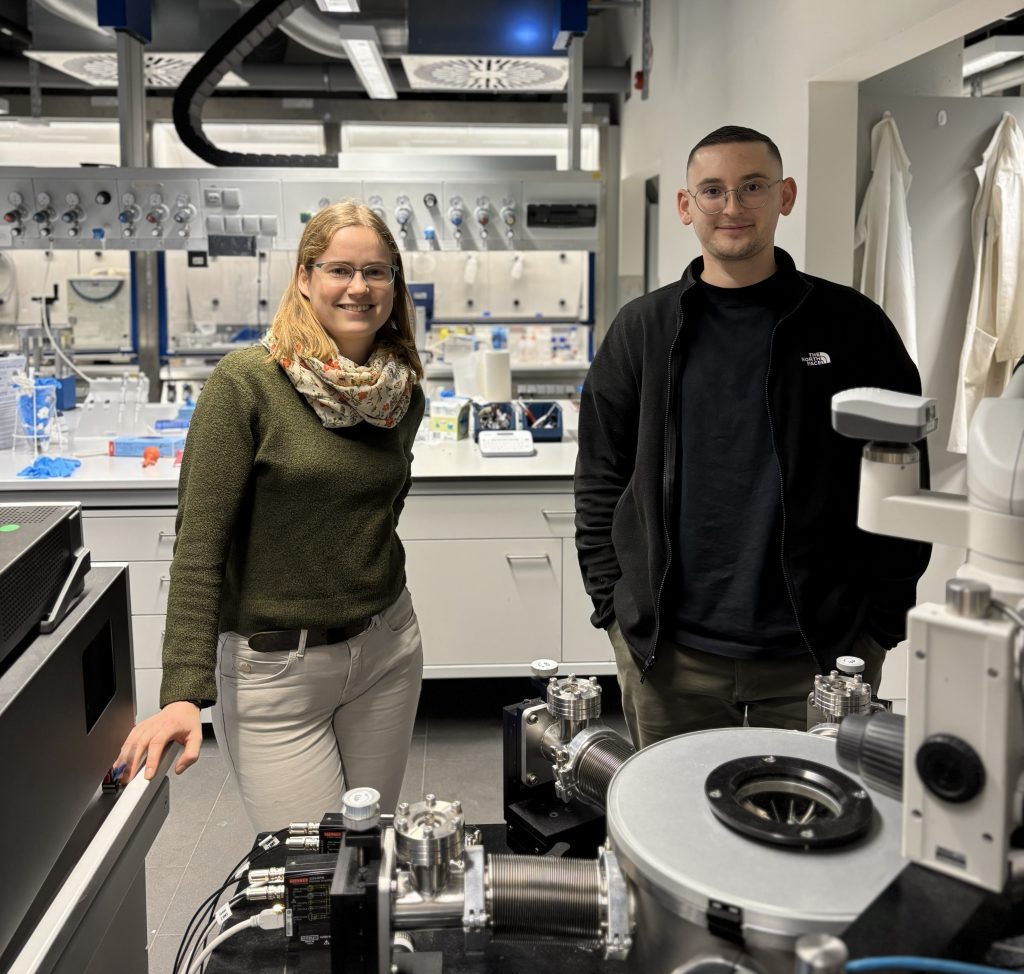
Lucie Quincke and Steffen Weinmann in the laboratory of Prof. Jennifer Rupp’s research group. (Photo: Lisa Winkler/TUM)
In everyday life, ceramics are commonly associated with items such as coffee cups and tiles. In modern materials science and energy technology, however, they play a far more significant role: functional ceramics are indispensable materials for batteries, electronics, aerospace, and high-temperature applications – and thus also for the energy future.
A recent review article published in Nature Nanotechnology brings these often overlooked materials into sharp focus. The publication, developed within the research group of Prof. Jennifer Rupp at the Technical University of Munich (TUM), provides the first systematic analysis of the sustainability of functional ceramics across their entire value chain – from raw material extraction and, in some cases, highly energy-intensive manufacturing processes through use, lifetime, and end-of-life considerations.
A broad range of applications with high relevance
Functional ceramics are characterized by their ability to deliver tailored electrical, thermal, or chemical properties. “They enable, among other things, cathode materials for lithium-ion batteries, material solutions for next-generation batteries, electronic components such as multilayer capacitors, thermal barrier coatings for turbines, and applications in aerospace. In these extreme temperatures, mechanical loads can occur,” explains Steffen Weinmann, doctoral researcher in Prof. Jennifer Rupp’s group and Head of Engineering at the start-up Qkera. “It is precisely this technological relevance that makes their environmental assessment increasingly important,” adds Lucie Quincke, who is also pursuing her doctorate in the same research group. Both are first authors of the review and took on the challenging task of structuring this highly heterogeneous field. To do so, they combined extensive literature research with numerous internal and external discussions in order to develop as comprehensive a picture as possible.
Why this review about sustainable materials is necessary
The primary motivation was the lack of a comprehensive scientific analysis of the sustainability of functional ceramics, despite their increasing technological importance. Prof. Jennifer Rupp, who initiated the idea for the review, summarizes the motivation as follows: “Functional ceramics are essential for many future technologies. At the same time, there has been no systematic assessment of how sustainability plays a role along the entire value chain. We wanted to close this gap. In our study, we bring together engineering and materials science, industry, and policy-makers around this important topic.”
No simple core messages
The team of authors deliberately avoids oversimplified conclusions. Instead, the review highlights the extreme diversity of functional ceramics in many respects. “In my view, there is no single central message in the classical sense,” explains Lucie Quincke. “The range of applications, processes, and optimization options is so broad that forming a uniform picture is hardly possible – and this is exactly what our review reflects. Direct comparisons between technologies are very challenging, as many approaches are still at early or very different stages of development.” This heterogeneity makes it difficult to derive robust assessments. Many technologies are still under development, and reliable life-cycle data are often missing or not standardized.
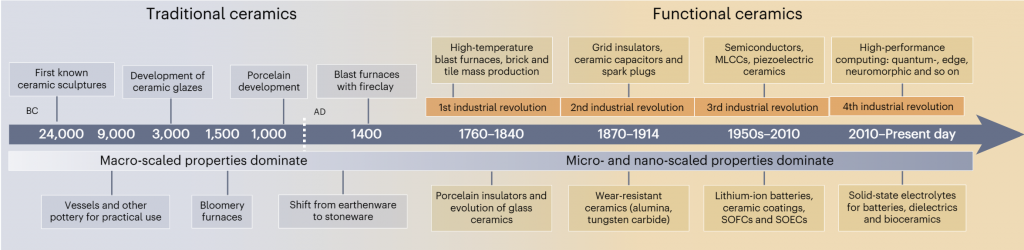
Historical development of structural and functional ceramics from their origins to the present day. (Sources see review)
Energy-intensive manufacturing processes as a key factor
High-temperature processes and complex process chains currently dominate industrial practice, and are a primary reason why traditional manufacturing processes for functional ceramics are energy-intensive and have a high carbon footprint. “Nevertheless, our research revealed an enormous number of levers that can be adjusted – particularly to reduce energy consumption and emissions,” says Steffen Weinmann. The review demonstrates that new process routes, alternative sintering methods, and material-efficient designs offer significant potential for improving sustainability.
Context from the scientific community
An accompanying editorial by Senior Editor Rinaldo Raccichini in Nature Nanotechnology further underscores the relevance of the topic. In it, sustainability is highlighted as a decisive factor for the technological maturity of future nanotechnology applications. Raccichini argues that sustainability aspects must be integrated early into research and development processes to create the conditions for technologies that are successful in the long term and accepted by society.
“With our review, we provide important impulses for research, industry, and policy, and make it clear that the energy transition is not only a systems issue, but also a materials issue,” emphasizes Rupp. “The fact that this comprehensive analysis was carried out by a team of early-career researchers and published in Nature Nanotechnology underlines the scientific quality and strategic relevance of their work – and sends a strong signal for the further development of sustainable materials research.”
Publication:
Steffen Weinmann, Lucie Quincke, Lisa Winkler, Jesse J. Hinricher, Fran Kurnia, Kun Joong Kim, Jennifer L.M. Rupp: Sustainable functional ceramics. Nature Nanotechnology (2025) https://doi.org/10.1038/s41565-025-02076-y
Contact:
Prof. Dr. Jennifer L.M. Rupp
Technical University of Munich
TUM School of Natural Science
Chair of Chemistry of Solid-State Electrolytes
Website: https://ecm-tum.de/
E-Mail: jrupp@tum.de