

 We proudly present the first podcast of the German Clusters of Excellence!
70 Clusters of Excellence – A Podcast: “Exzellent erklärt” regularly reports from one of the research consortia funded as part of the federal and state governments’ Excellence Strategy. The journey takes listeners across the country, and the topics are just as diverse as the locations: from A for African Studies to Z for the Future of Medicine. In each episode, podcaster Larissa Vassilian interviews researchers from one of the Clusters of Excellence. All Clusters of Excellence share a common motivation: they address important issues of our time, tackle extraordinary questions, and conduct research for the society of tomorrow. The podcast concept was developed by a team of ten science communication experts from ten Clusters of Excellence – including e-conversion and two more Munich clusters, MCQST and SyNergy. You can find the German-language podcast on all popular platforms such as Apple Podcasts, Spotify, Amazon Music,… Or visit the website: www.exzellent-erklaert.de
e-conversion has already published three podcast episodes
Folge 11 “Energieforschung – Starke Akkus für die Energiewende” (Link)
 In 2030, more than ten million electric cars will populate the roads in Germany. And all of them will need a powerful, fast-charging and safe battery. How is that going to happen? In this episode, Prof. Dr. Bettina Lotsch and Sina Stegmaier provide insight into battery research. What are the problems of current rechargeable batteries? And how could they be solved? The two chemists from the Cluster of Excellence e-conversion also explain how batteries actually work and what materials are needed for a high-performance battery. And they reveal what solid-state batteries are all about, in which the automotive industry in particular has such high hopes.
Folge 46 “Energie aus Licht – Die Magie der Photoelektrokatalyse” (Link)
 Energy storage is one of the major issues of our time. Photoelectrocatalysis can make a difference here. For example, solar batteries could simultaneously absorb, convert, store, and release sunlight. In this basic research, it is important to find the right materials to ensure that they work as efficiently as possible. The scientists are delving deep into the nanocosmos and identifying properties that have a huge impact on performance.
Folge 71 “Gefaltete DNA – Photonische Kristalle und die Energie von morgen” (Link)
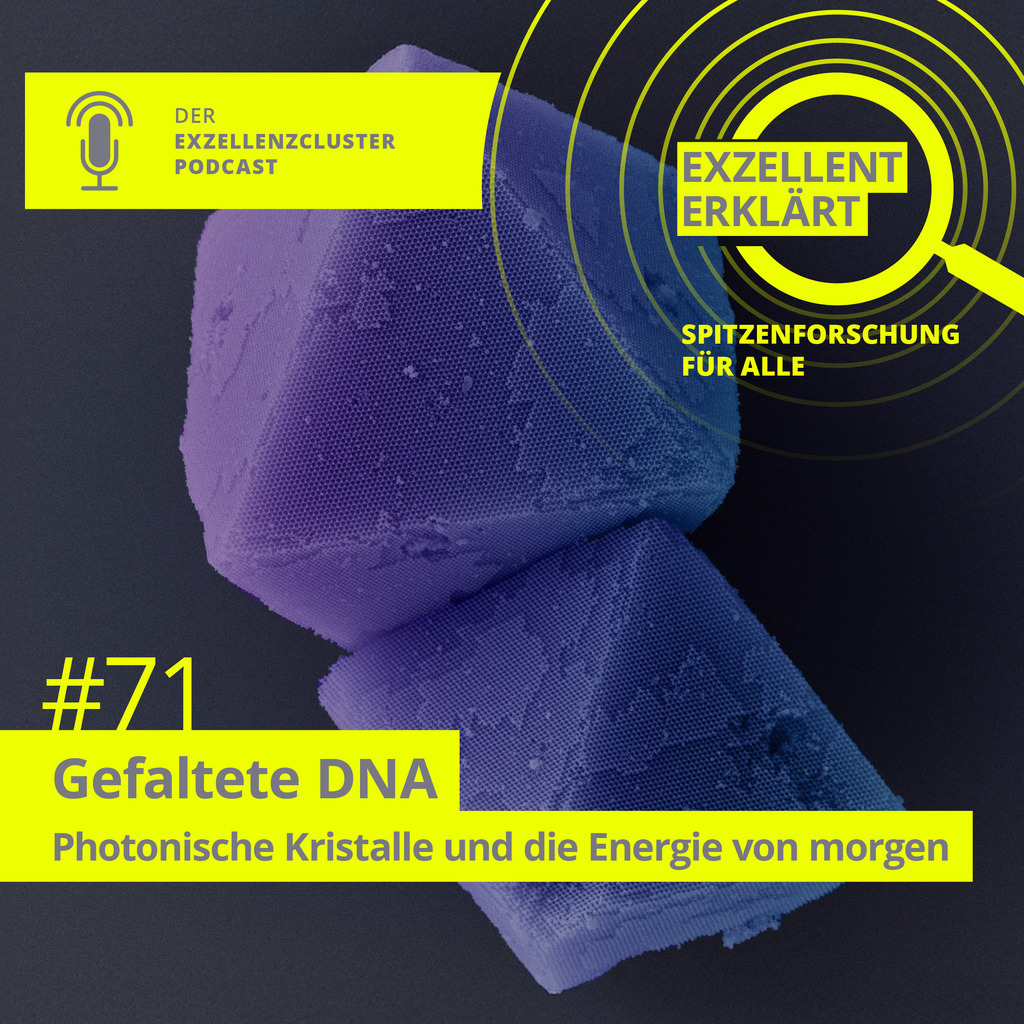 What does the Japanese art of paper folding, origami, have to do with energy research? Surprisingly a lot! In this episode, we dive into the world of DNA nanotechnology—a field of research that blurs the boundaries between biology, physics, and materials science. Scientists Philipp Tinnefeld and Tim Liedl explain that DNA is not only suitable as a carrier of genetic information but also serves as a highly precise building material for tiny structures on the nanometer scale.