

Solid electrolytes are central to the development of all-solid-state batteries, which promise safer, more energy-dense alternatives to conventional lithium-ion systems. Fast ionic conduction, in which charged atoms, or ions, move rapidly through a solid crystal lattice, determines how efficiently these batteries can operate. However, reliably detecting and predicting this behavior has long posed a challenge for both experimentalists and theorists.
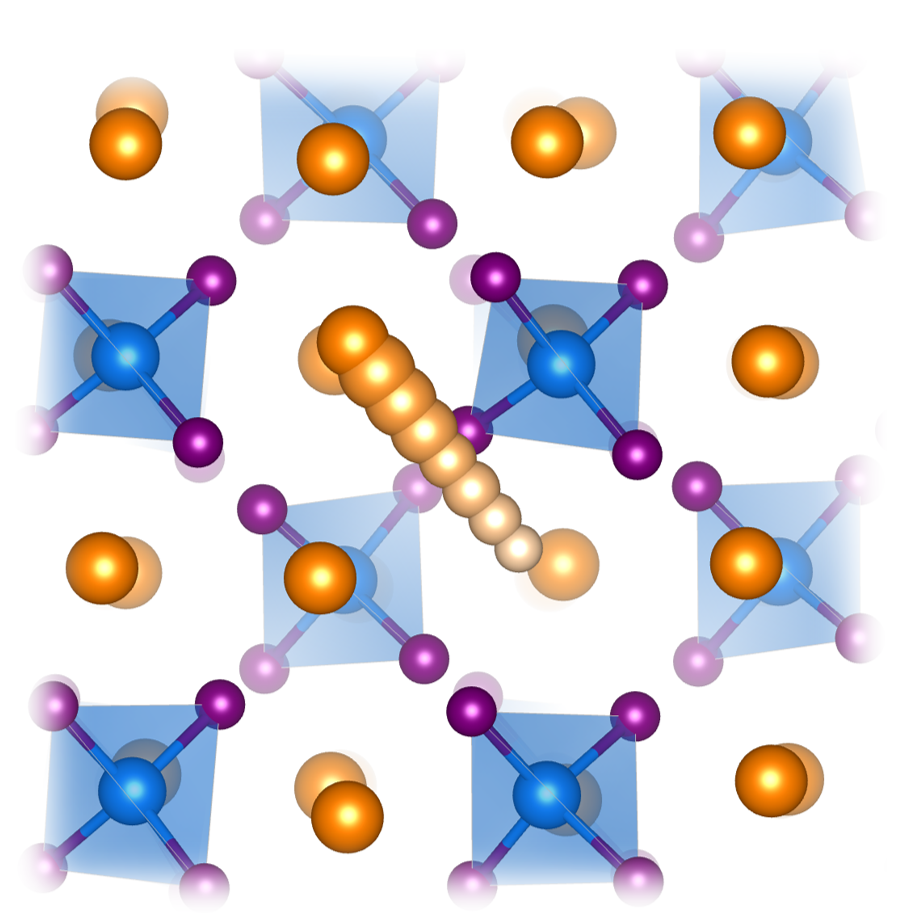
Mobile ions (in orange) move through the atomic structure of a sodium solid electrolyte material. By predicting its Raman spectrum with AI-guided computations, the authors identify materials suitable for next-generation batteries. (Illustration: Dr. Manuel Grumet, Dr. Waldemar Kaiser / TUM)
Tracking ion motion through Raman “signatures”
Previous studies suggest that when ions move in a “liquid-like” manner inside a crystal, they can disrupt its symmetry. This disruption affects the material’s Raman spectrum, a type of vibrational fingerprint detected using light. Fast-moving ions generate low frequency, diffusive Raman scattering that can serve as a tell-tale sign of high ionic mobility. The new study, which includes the theoretical and computational work of Prof. David Egger’s research group at TUM School of Natural Sciences and collaborators at the Swiss Federal Technology Institute of Lausanne (EPFL), builds on that insight by creating a machine-learning-accelerated computational pipeline capable of predicting these Raman signatures with high accuracy. Traditional Raman calculations for disordered, dynamically fluctuating materials require immense computing power, making broad materials screening impractical. By integrating machine learning into the workflow, the researchers dramatically reduced computational cost while retaining scientific accuracy.
A breakthrough for energy materials discovery
To demonstrate the method’s power, the team applied it to sodium-ion conducting solid electrolytes, an emerging alternative to lithium-based systems. The pipeline successfully identified clear Raman features associated with liquid-like ionic motion, validating the approach and showing that it can predict fast ion conduction from atomistic simulations alone. These results point to a new way of bridging the gap between theoretical simulations and experimental measurements, enabling faster screening and discovery of promising electrolytes for sustainable energy technologies. The approach could accelerate the search for materials vital for high-performance solid-state batteries and other energy storage applications.
Publication:
Manuel Grumet, Takeru Miyagawa, Olivier Pittet, Paulo Pegolo, Karin S. Thalmann, Waldemar Kaiser, David Egger. Revealing Fast Ionic Conduction in Solid Electrolytes through Machine Learning Accelerated Raman Calculations, AI for Science, doi: 10.1088/3050-287X/ae411a
Contact about the scientific article:
Prof. David Egger
Professor for Theory of Functional Energy Materials
https://theofem.de/
+49 89 289 12390
david.egger@tum.de
Further information and links:
- Atomistic Modeling Center of the Munich Data Science Institute
- TUM-Oerlikon Advanced Manufacturing Institute
Press contact:
communications@nat.tum.de
Team website
Pressekontakt