

Six partners from research and industry, including the Helmholtz-Zentrum Berlin (HZB), the Fritz Haber Institute of the Max Planck Society (FHI), BASF, Siemens Energy, Dunia Innovations, and the Technical University Berlin/BasCat are launching a joint project to accelerate catalyst discovery. The German Federal Ministry for Science, Technology and Space (BMFTR) is providing €30 million in funding for the project ASCEND (Accelerated Solutions for Catalysis using Emerging Nanotechnology and Digital Innovation). The research initiative targets the defossilization of energy-intensive industries while safeguarding industrial competitiveness, with a focus on the chemical sector. The five-year project will start on April 1, 2026.
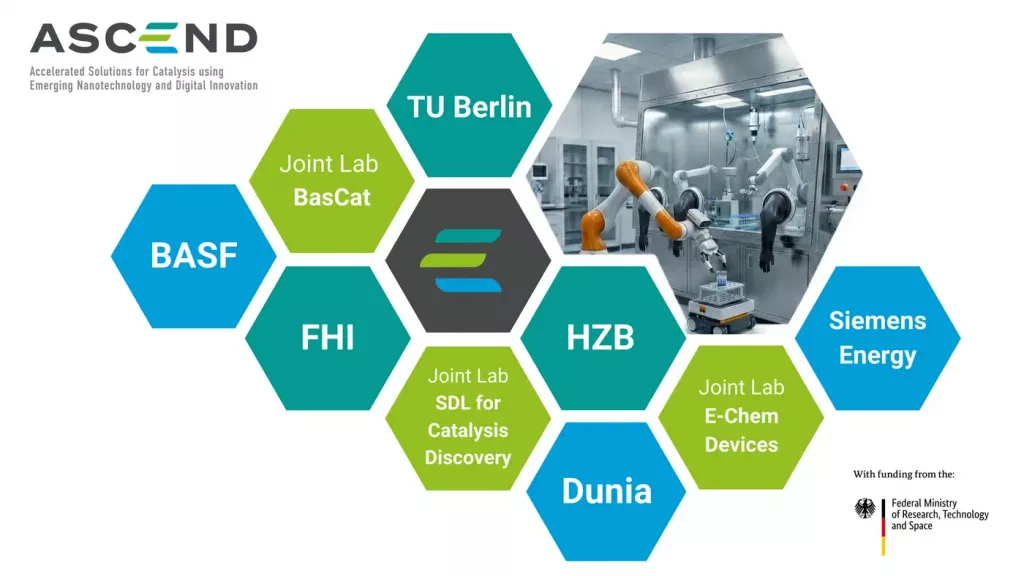
Consortium partners and planned joint ventures. Image on the right-hand side generated with AI.
ASCEND aims to accelerate the development of next-generation catalysts, a cornerstone of sustainable chemical production. For this it brings together two breakthrough approaches: Digital Catalysis and thin-film catalyst technologies. Digital Catalysis uses Artificial Intelligence (AI), simulations, and automated self-driving laboratories (SDLs) to speed up the discovery of high-performance materials, while thin-film processing reduces material use and improves efficiency. Combined with 3D structures, these catalysts enhance surface area and reaction control, towards the goal of providing sustainable syn-fuels and base chemicals as drop-in substitutes in industry.
AI-accelerated material development
At the heart of ASCEND’s approach is AI, which, together with automation and robotics, powers SDLs to accelerate scientific experiments. The AI autonomously builds and updates digital twins of the systems under study and bases its design decisions on these models. It designs experiments that are carried out by automated systems in iterative learning loops, using each result to improve the next step. While AI significantly speeds up planning and efficiency, humans remain essential for guiding the overall approach and defining the scientific questions. The project builds on the long-term successful partnership between the Fritz Haber Institute and the Helmholtz-Zentrum Berlin to drive forward catalysis research. The scientific project coordinators emphasize the strategic importance of the funding: “The AI-driven approach of ASCEND allows us to explore vast material spaces that were previously inaccessible,” says FHI project manager Karsten Reuter, who is also a member of the e-conversion Cluster of Excellence. His co-project lead Michelle Browne from HZB adds “it fundamentally changes how fast the science can deliver the solutions chemical industry urgently needs.”
“The goal is not autonomous experimentation for its own sake, but industrially trustworthy results. In ASCEND, by combining AI with physical synthesis and stress testing under manufacturing-relevant conditions, Dunia accelerates learning while maintaining confidence at scale,” says Marcus Tze-Kiat Ng, Chief Technology Officer of Dunia Innovations.
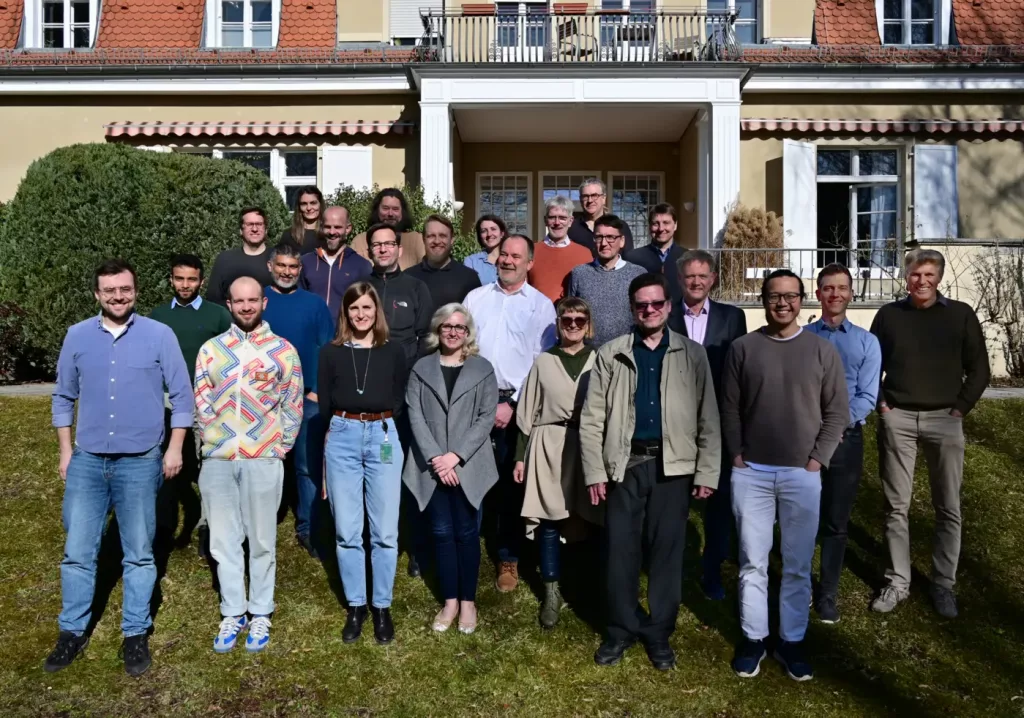
The ASCEND team at the intern kick-off meeting. © Steffen Kangowski
From research to industrial application: Strengthening technology leadership
By accelerating catalyst development cycles, ASCEND aims to unlock the performance breakthroughs needed for commercially viable, large-scale deployment of green hydrogen and sustainable chemicals. This is an important prerequisite for the industry to become independent of coal and oil products.
Background
According to S&P Global Ratings, the chemical industry is accountable for approximately six per cent of global greenhouse gas emissions. This corresponds to the annual emissions of the European Union (according to EDGAR – Emissions Database for Global Atmospheric Research). These emissions are primarily generated during electricity production in power stations, where fossil fuels are burned. They are also produced during the manufacture of plastics, fertilisers and pharmaceuticals, which are mainly derived from fossil fuels. Catalysts can provide a solution. According to estimates, around eighty per cent of all chemical products undergo a catalytic stage in their manufacturing process. Innovations in the field of catalysts are therefore crucial for industrial transformation with the aim of reaching greenhouse gas-neutral production by 2050.