

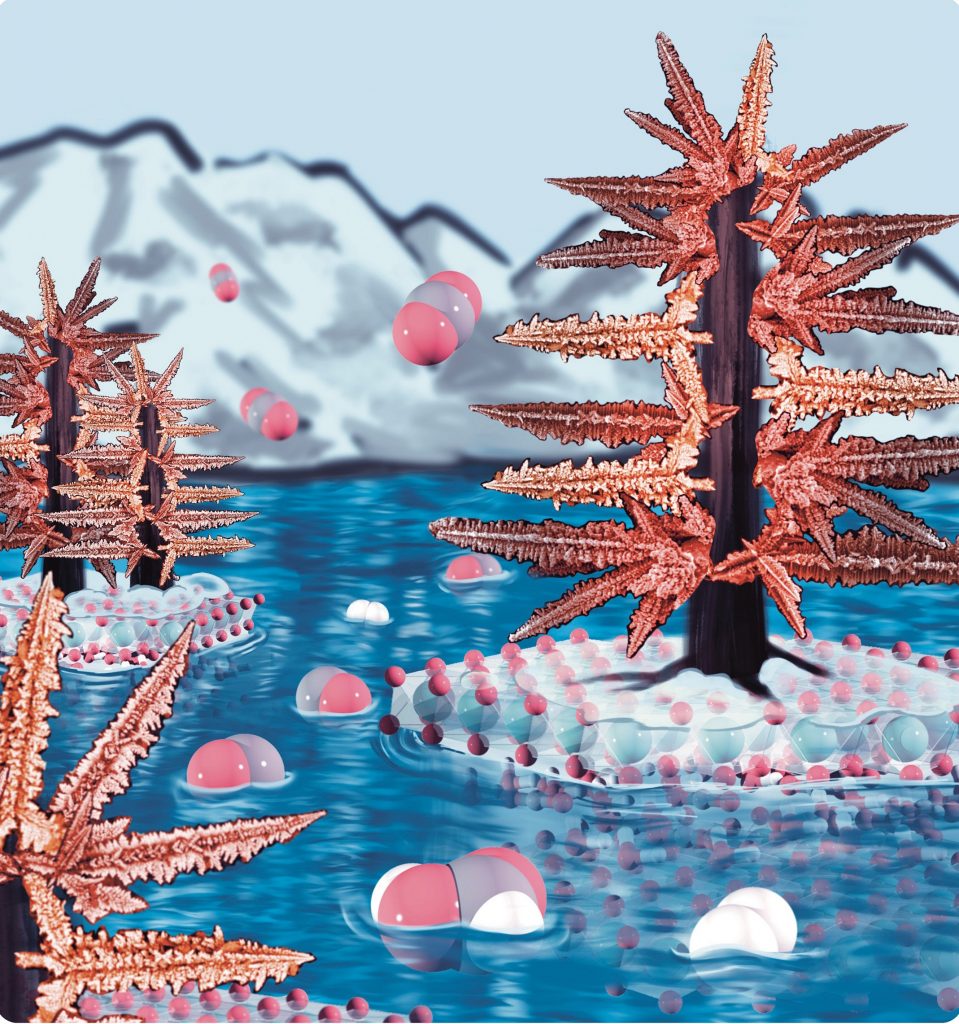
Artwork by Amelie Heilmaier, originally created as cover art for Chemistry of Materials. Used with permission of the artist. https://doi.org/10.1021/acs.chemmater.5c01903
Not all industrial processes can be made climate-neutral – for example, when carbon dioxide is produced as part of a chemical reaction. To reduce such emissions, one particular strategy is gaining attention: instead of simply capturing the resulting CO₂, it can be used as a feedstock for new chemical products, thereby replacing fossil resources. A research team at the Max Planck Institute for Solid State Research in Stuttgart reports in the journal Chemistry of Materials on a new approach to electrochemically convert CO₂ into syngas (a mixture of carbon monoxide and hydrogen) and formic acid – two important feedstocks for the chemical industry. “There are processes, such as cement production, where carbon dioxide is inevitably released,” explains Luca Camuti. The chemist is a doctoral researcher in the group of Prof. Bettina V. Lotsch, whose work is funded by the Cluster of Excellence e-conversion. “To convert carbon dioxide electrochemically – that is, to carry out CO₂ reduction so that the desired products are formed efficiently and selectively – a suitable catalyst is required.” But how can this ideal reaction mediator be obtained?
Progress through stepping back
To answer this question, the chemist went back to the precursors of his catalyst: layered double hydroxides (LDHs), made of aluminum and copper. These materials are characterized by a sandwich-like structure consisting of layers of mixed copper and aluminum hydroxides, separated by carbonate ions and water molecules. “As soon as we apply a negative voltage, the material fundamentally changes and transforms into its active form,” Camuti explains. “The LDHs are precatalysts – the starting point for the actual catalyst.” Once formed, it converts CO₂ into syngas – in tunable ratios – and formic acid. One advantage: The products appear in different phases and can be used without additional purification steps. “In contrast to other copper catalysts, which often produce a broad mixture of products, our system shows a narrow product distribution,” says Prof. Bettina Lotsch. “At the same time, the ratio of carbon monoxide to hydrogen is already within a range suitable for industrial processes.”
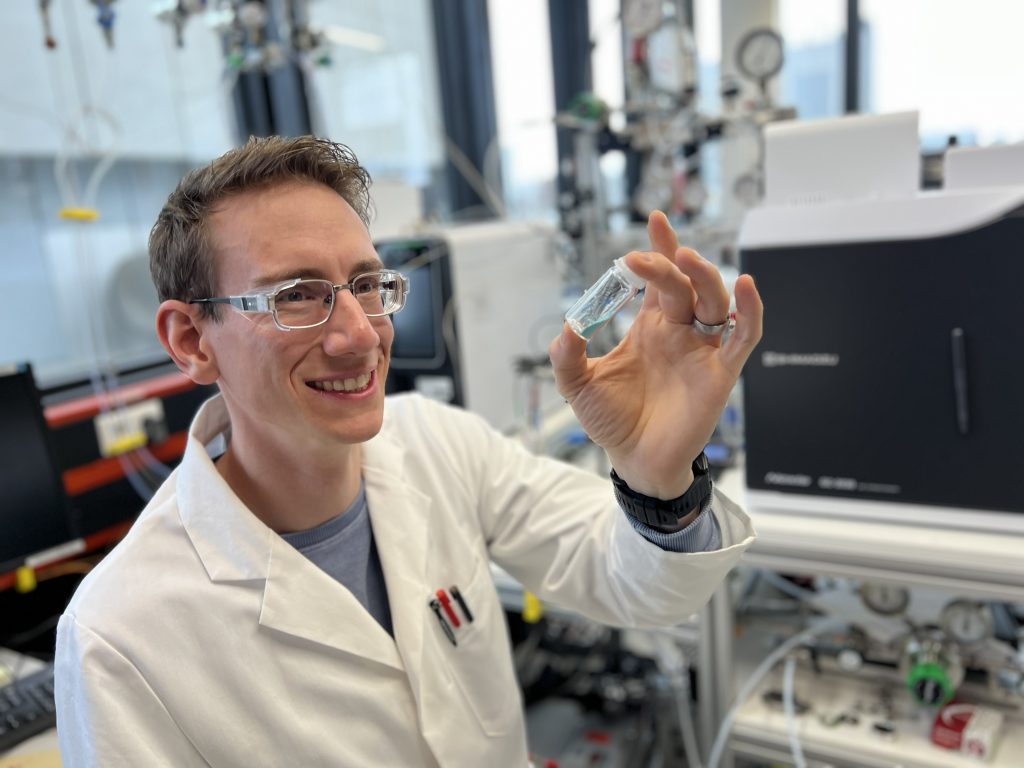
In his study, Luca Camuti demonstrated that it is beneficial to develop precatalysts that convert specifically into an active structure under specific reaction conditions. (Photo: Amelie Heilmaier/MPI FKF)
Copper ‘trees’ at the nanoscale
Luca Camuti describes in detail how the transformation of the LDHs proceeds: When the material is placed in an electrochemical environment, part of the copper dissolves and then redeposits. “This leads to the growth of a dendritic copper structure. These finely branched nano- and microstructures constitute the actual catalytically active phase,” he explains. The activity of the system even increases over the course of the reaction: While the measurement is in progress, new dendrites continue to form, causing more and more CO₂ to be converted.
The performance of the catalyst depends critically on the ratio of copper to aluminum. By tuning the composition, the morphology of the copper dendrites can be controlled. “Less copper leads to smaller, finer dendrites, while a higher copper content results in longer, feather-like structures,” the chemist explains. A clear trend emerges: systems with lower copper content are significantly more active per copper atom. One possible explanation is that smaller dendrites provide a larger active surface area relative to their size.
Instability as an advantage
The study highlights an important approach for developing future electrocatalysts: it can be beneficial to design precatalysts that deliberately transform into an active structure under specific reaction conditions. “In essence, we exploit the instability of the LDH material to generate the actual catalyst,” says Lotsch. “That may sound contradictory at first, but our system shows that it pays off to take a step back and establish the right chemical structures and conditions.”
Publication:
Cu–Al Layered Double Hydroxides as Precursors to Operando-Formed Dendritic Cu for Electrochemical CO₂ Reduction; L. Camuti, F. Heck, V. Sprenger, N. Weiß, C. Schneider, V. Duppel, R.K. Kremer, S. Bette, B. V. Lotsch
https://doi.org/10.1021/acs.chemmater.5c01903
Contact:
Prof. Bettina V. Lotsch
Nanochemistry Department
Max Planck Institute for Solid State Research
Email: b.lotsch@fkf.mpg.de
Website: https://www.fkf.mpg.de/lotsch