

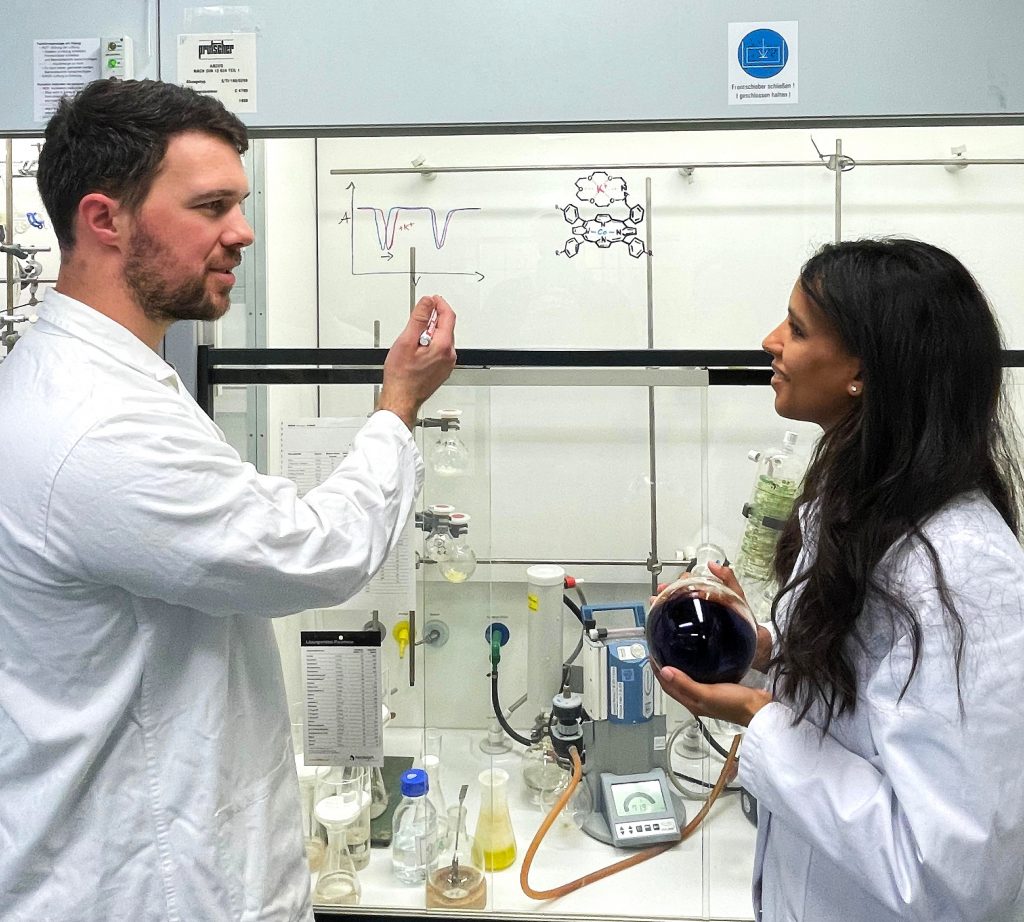
In the lab, Christian Wilhelm and Rahel Hoffmann discuss how crown ethers can positively influence the molecular catalyst. (Photo: A. Deeg / LMU)
Transforming carbon dioxide into a useful product is one of the major goals of energy research – and a significant challenge at the same time. As a highly stable molecule, carbon dioxide reacts only minimally without a suitable catalyst. "CO₂ is very inert. To make it industrially viable, the first step is to efficiently convert the molecule into carbon monoxide, or CO. This molecule, in turn, is an important building block for the chemical industry," says Christian Wilhelm. He is a chemist and doctoral researcher in the group of Prof. Ivana Ivanović-Burmazović, which conducts research within the Cluster of Excellence e-conversion at LMU Munich. "Worldwide, mainly inorganic materials are being tested as catalysts. They are often based on expensive or rare metals such as gold, platinum, or copper. In contrast, we investigate molecular catalysts – specifically cobalt porphyrins." Porphyrins are ring-shaped molecules that coordinate a metal ion at their center, similar to the heme group in hemoglobin, where an iron ion is bound within a porphyrin ring. In our case, the metal is cobalt. The cobalt ion performs the actual catalytic function: binding and converting CO₂ into CO. How this process can be made more efficient – and what helpful role crown ethers can play – has now been published by the LMU researchers together with the team of Prof. Dr. Ulf-Peter Apfel at Ruhr University Bochum and the Fraunhofer Institute for Environmental, Safety, and Energy Technology (UMSICHT) in Oberhausen in the journal Angewandte Chemie.
Beyond the metal, a precisely created environment matters
The molecular framework surrounding the cobalt ion is not merely decorative. "It is well known that catalytic activity and selectivity can be controlled very precisely by electrostatic influences within the chemical environment of the catalytic center," explains Prof. Ivana Ivanović-Burmazović. "Through appropriate chemical groups, positive charges can be positioned near the catalytic center, which in the case of a reduction can stabilize reactive intermediates and lower the overpotential." To redesign this chemical environment, doctoral researcher Christian Wilhelm turned to crown ethers. These are also ring-shaped molecules containing several oxygen atoms. Together with his LMU colleague Rahel Hoffmann, he synthesized compounds in which the crown ethers are positioned in close proximity to the cobalt center. "With the help of crown ethers, we can bind cations that influence the local electrostatic field around the cobalt center – essentially in a second coordination sphere," Wilhelm explains. "This subtly affects the electron density distribution in the system and shifts the reaction toward the desired pathway – namely CO₂ reduction to CO." Electrochemical measurements confirmed that this strategy works: CO₂ reduction is energetically favored and becomes more selective, leading to increased CO formation.
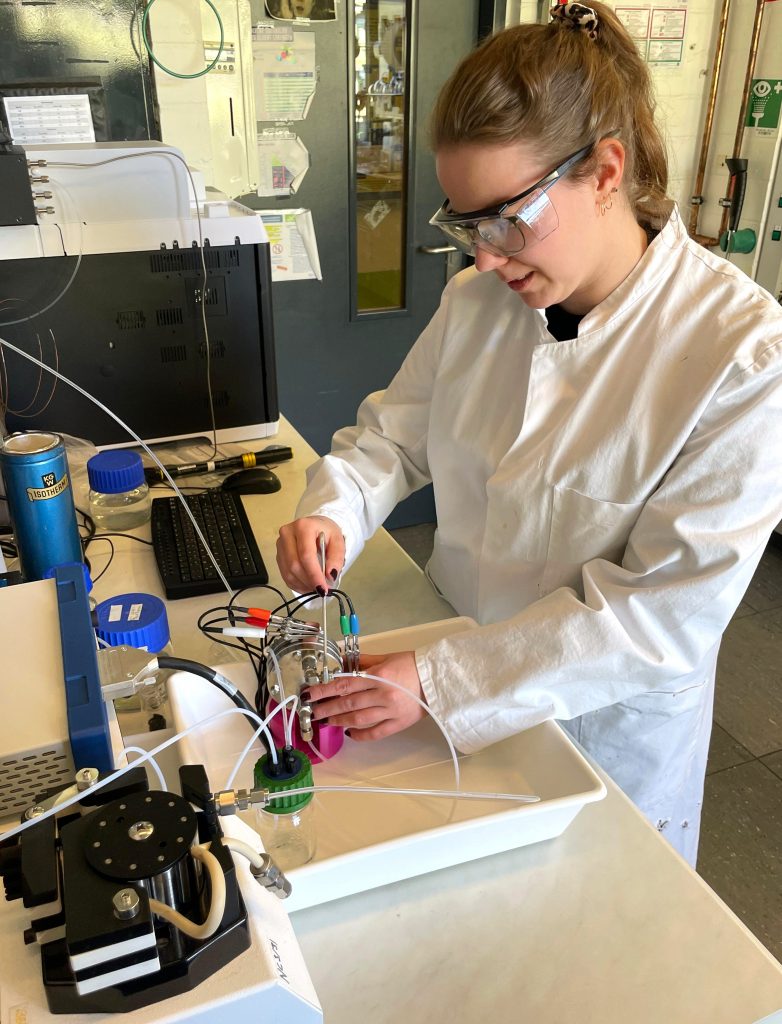
Doctoral student Wiebke Wiesner is testing the performance of the LMU researchers' molecular catalyst in a zero-gap electrolyzer. (Photo: A. Wiesner / Ruhr University Bochum)
From a homogeneous system to a technical cell
In the next step, Wiebke Wiesner, a doctoral researcher in the group of Prof. Dr. Ulf-Peter Apfel at Ruhr University Bochum, investigated the molecular catalyst in a so-called zero-gap electrolyzer. In this cell architecture, the electrode and membrane are placed directly adjacent to each other, enabling significantly more efficient catalysis compared to conventional systems. CO₂ flows through the porous electrode structure directly past the catalytic surface. As a result, the contact area between gas and catalyst is particularly large, which is why zero-gap electrolyzers are considered a promising concept for industrial applications. The results are encouraging: "We achieved high CO selectivities at moderate current densities and a Faradaic efficiency of 43 percent at high current densities," says Wilhelm. "To our knowledge, these are currently the best values reported for non-noble molecular catalysts in such a system." Current densities in the range of 300 to 500 mA/cm² are therefore coming within reach for molecular approaches – largely due to the stabilizing effect of the crown ethers that bind positive cations. For molecular catalysts, this represents an important step forward.
The researchers are aware that inorganic noble-metal catalysts can achieve higher absolute efficiencies. "Nevertheless, we want to demonstrate with our molecular systems that greater sustainability is possible," says Prof. Ivanović-Burmazović. "Cobalt is significantly more cost-effective and more readily available than gold, silver, or platinum. The key lies in the design principle: through targeted and relatively small structural modifications which modulate electrostatic interactions, the reaction environment can be finely tuned." Crown ethers have so far rarely been explored systematically as stabilizing elements in electrocatalysis. Their use could also be transferable to other catalytic systems.
Publication:
Heavy is the Crown: Crown Ether Modulation of Cobalt Porphyrin CO2 Electroreduction in Zero-Gap Electrolyzers; W. Wiesner, C. Wilhelm, R.C. Hoffmann, P. Stahl, K. Pellumbi, J. Jökel, I. Ivanović-Burmazović, U. Apfel
https://doi.org/10.1002/anie.202525189
Contact:
Prof. Dr. Ivana Ivanović-Burmazović
Chemistry Department
Ludwig-Maximilians-Universität München
E-Mail: ivana.ivanovic-burmazovic@cup.uni-muenchen.de
Website: https://ivanovic.cup.uni-muenchen.de/