

By fusing physics with machine learning, researchers model complex energy materials at real-world temperatures and scales. Prof. David Egger’s research team at the Technical University of Munich (TUM) School of Natural Sciences has developed a powerful new computational framework that could accelerate the design of future solar energy materials. The method, called Hamster (Hamiltonian-learning Approach for Multiscale Simulations using a Transferable and Efficient Representation), enables realistic, quantum-accurate simulations of complex materials under real operating conditions, something long considered out of reach with conventional methods. The work was recently published in Nature Communications.

Logo for the Hamster project. Illustration: AI-generated concept sketch created with OpenAI tools.
“With Hamster, we can finally simulate complex energy materials under the conditions where they actually operate,” says Prof. Egger. “This ability to combine physical insight with data-efficient machine learning represents a major step toward truly predictive materials design.”
Nextgeneration photovoltaic materials like halide perovskites behave in ways that are strongly shaped by temperature, atomic motion, and structural disorder. Traditional quantummechanical simulations struggle with these effects because they require enormous computational resources and typically only handle idealized, lowtemperature structures. Hamster overcomes this limitation by combining an approximate physics model with machine learning to capture subtle, dynamic changes in a material’s electronic structure. As a result, the approach predicts optoelectronic properties with firstprinciples accuracy while requiring only a fraction of the training data used by neuralnetwork models.
One of Hamster’s most significant achievements is its ability to scale quantum predictions to systems containing tens of thousands of atoms, a regime that has been effectively inaccessible with standard density functional theory (DFT). The team applied their method to large halide perovskite supercells of up to 50,000 atoms, revealing how thermal fluctuations, composition, and system size influence key properties, such as the electronic band gap. These large-scale simulations help eliminate finite-size artifacts, providing a far more realistic picture of how materials behave in real experiments.
.
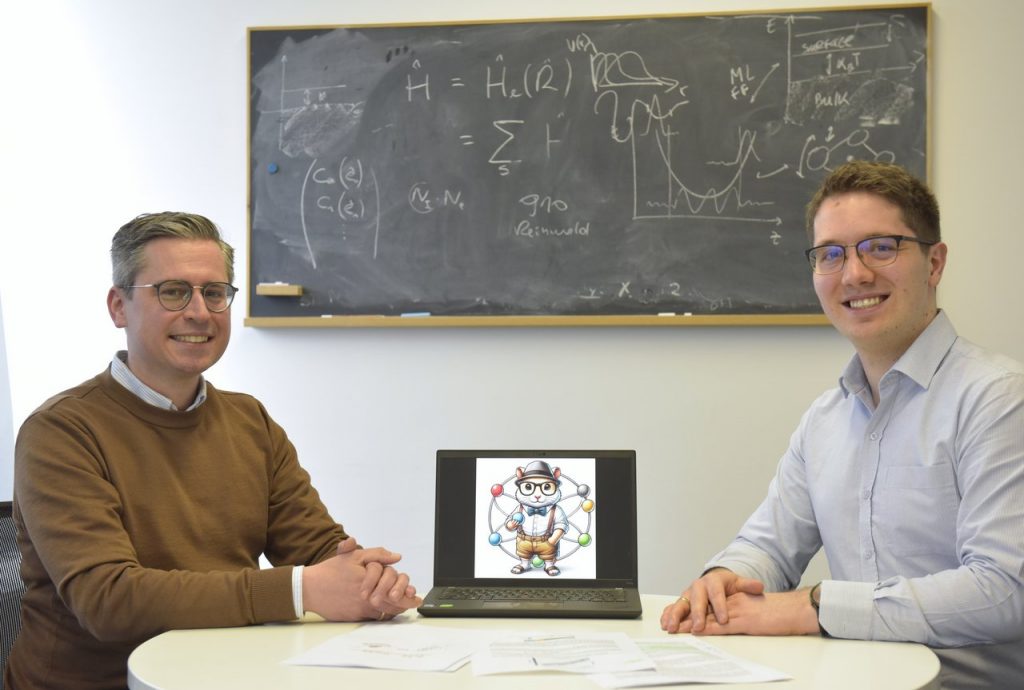
Prof. David Egger (left) and Martin Schwade present the HAMSTER project. (Photo: Dr. Robert Reich / TUM)
Beyond its computational power, Hamster stands out for its interpretability and data efficiency. “The Hamiltonian, the ‘H’ in Hamster, is essentially a very large table describing a material’s state and evolution, structured by symmetry, much like a CV,” says Martin Schwade, first author of the study and doctoral researcher in Prof. Egger’s group, who led the development of the Hamster code. “Unlike black-box AI models, Hamster embeds these symmetries directly into its architecture, enabling it to efficiently learn the physics of electronic interactions.” This design not only reduces the amount of data required for training but also ensures that the model’s predictions remain physically meaningful across different temperatures, compositions, and material types.
By enabling accurate, scalable simulations under conditions that closely mimic real-world operation, Hamster opens the door to more predictive materials research: from solar cells and light-emitting devices to quantum materials with complex disorder. The team’s work demonstrates how combining physics and AI can unlock new capabilities in materials modeling, facilitating faster discovery and optimization of high-performance energy technologies.
Publication:
Martin Schwade, Shaoming Zhang, Frederik Vonhoff, Frederico P. Delgado, and David A. Egger. Physics-informed Hamiltonian learning for large-scale optoelectronic property prediction. Nature Communications. doi: 10.1038/s41467-026-70865-7
Contact about the article:
Prof. David Egger
TUM School of Natural Sciences
Theory of Functional Energy Materials (TheoFEM)
Tel. +49 89 289 12390
david.egger@tum.de
Press contact:
communications@nat.tum.de
Link to original article
More information, funding, and links:
- Atomistic Modeling Center
- Munich Data Science Institute
- Solar Technologies Go Hybrid, funded by the Bavarian State Ministry for Science and Art
- German Research Foundation’s Priority Programme “Perovskite Semiconductors: From Fundamental Properties to Devices” (SPP 2196)