

How can the next generation of batteries become safer, more powerful, and industrially scalable? This mission drives the Munich-based start-up Qkera, which has gained strong financial backing for its next steps. Following a recently closed seven-figure pre-seed funding round led by EIT InnoEnergy, Qkera will accelerate industrial validation, develop large-scale prototypes, and establish a pilot line by 2026.
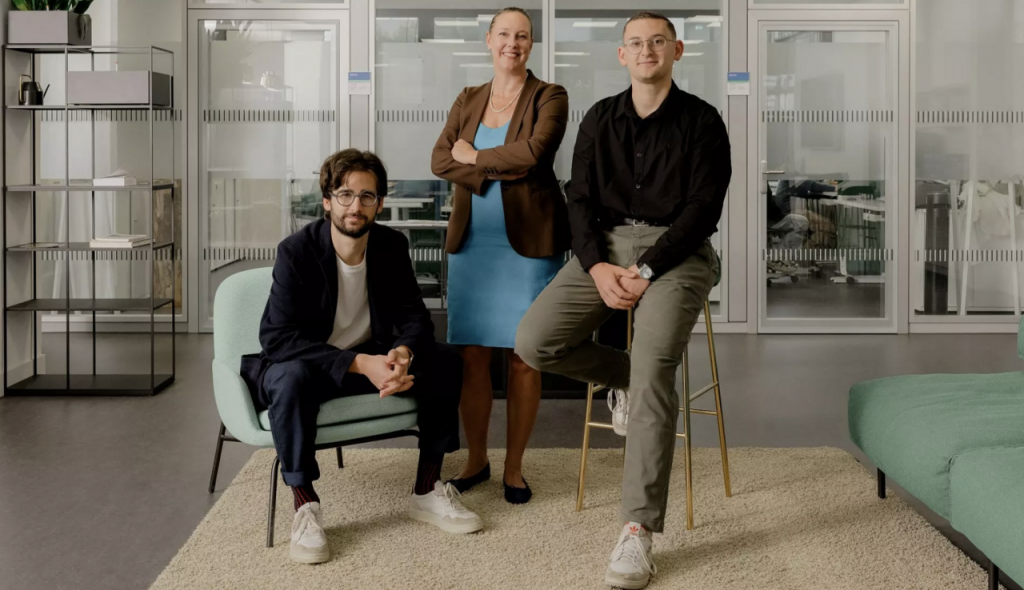
Qkera on the road to success: Dr. Andreas Weis, Prof. Jennifer Rupp and Steffen Weinmann (from left). Photo: Qkera
Founded in 2024 within the ecosystem of the Excellence Cluster e-conversion as a spin-off from the Technical University of Munich (TUM) and the Massachusetts Institute of Technology (MIT), Qkera develops thin, flexible solid-state electrolytes for lithium-ion batteries that can store more energy, charge faster, and offer improved safety compared to conventional batteries. The company uses a unique chemical process to produce ceramic electrolyte layers in a single step and at low temperatures, resulting in materials that are cost-efficient, scalable, and compatible with existing production lines. With this approach, Qkera aims to enable the industrial breakthrough of solid-state batteries while strengthening Europe’s battery value chain. “We are delighted to be working with Qkera on the next generation of solid-state batteries,” says Christian Bauer, CEO DACH at InnoEnergy. “The electrolyte component developed by Qkera has the potential to help this key technology achieve a breakthrough in a rapidly growing market.” The pre-seed funding marks a major step toward mass-market solid-state batteries that can be manufactured using existing production processes — without major infrastructure changes.
Start-up journey: A crash course in leadership
Beyond technological innovation, Qkera also champions leadership and diversity. The company was founded by Prof. Jennifer Rupp (Chief Strategy Officer) — one of only a few female deep-tech founders in Germany — and Dr. Andreas Weis. “With InnoEnergy’s support and unrivaled network, we are poised to scale up our process, finalize key development agreements, and advance the commercialization of next-generation battery technology,” explains Dr. Andreas Weis and Prof. Jennifer Rupp adds: “With InnoEnergy and their extensive portfolio of energy start-ups, strong network, and leadership in the European Battery Alliance, we could not have asked for a better partner to help us scale our technology.” Qkera’s success story demonstrates how academic research can leap from industrial application to entrepreneurship, and it’s a prime example of the innovation culture fostered at e-conversion – where fundamental research meets entrepreneurial spirit to shape the energy technologies of tomorrow.
Behind every technological innovation lies a personal story. In our interview with Qkera co-founder Dr. Andreas Weis, he shares how a research idea grew into a company that is rethinking battery manufacturing in Europe.