

Materials scientist Prof. Jennifer L.M. Rupp, head of the Electrochemical Materials Lab at the Technical University of Munich and spokesperson for the e-conversion Cluster of Excellence, is researching innovative concepts for sustainable energy conversion and storage. Through the Max Planck Fellow Program, she also works at the Fritz Haber Institute (FHI) of the Max Planck Society. The program promotes collaboration between outstanding university teachers and researchers from the Max Planck Society and involves leading a small working group at a Max Planck Institute. In an interview with the FHI, Jennifer Rupp explains how she plans to spend her five-year Max Planck Fellowship researching solar batteries and optoionic technologies together with Prof. Dr. Beatriz Roldan Cuenya and Prof. Dr. Karsten Reuter.
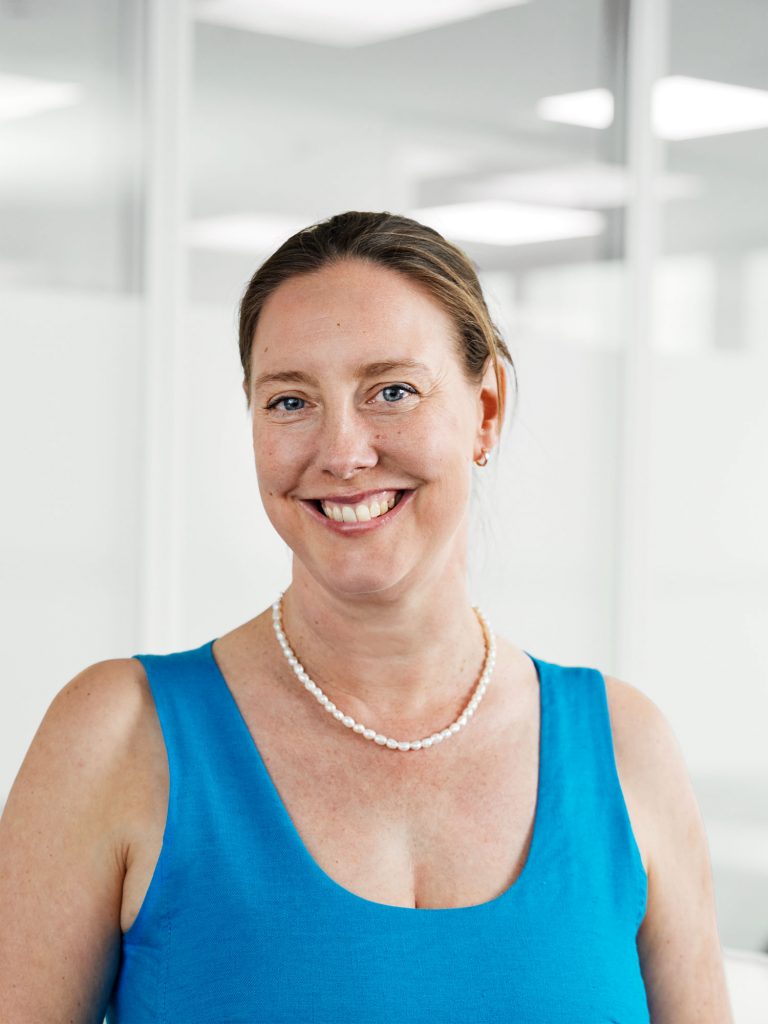
Prof. Dr. Jennifer Rupp (Photo: TUMint.Energy Research GmbH/Detlef Schneider Photography ©)
What is the focus of your research and how does it relate to the work at the Fritz Haber Institute?
With my research group at the TU Munich, I investigate the properties of solids, particularly with regard to their use in sustainable energy conversion and storage. On the one hand, we try to understand such solids in detail and explain their behavior mechanistically. In addition, we are also working on the development of very specific new components. My group works primarily experimentally and in a very interdisciplinary manner: Currently, around 25 researchers from the fields of chemistry, materials science, engineering, electrical engineering, and physics are coming together to develop new components. Specifically, we are working on optoionic and thermal batteries, for example, which play a role in the energy transition. A pretty different project is the development of completely new types of batteries for medical implants that can convert glucose present in our bodies into electricity. Researchers at the Fritz Haber Institute are also working on the further development of energy materials and possibilities for energy conversion and storage. The expertise available here is different from that of my working group in Munich, so combining our knowledge is very useful and promising.
How does the collaboration with the Fritz Haber Institute expand your research?
The idea to work closely with researchers at the Fritz Haber Institute stems from the plan to develop new optoionic batteries and technologies. Prof. Dr. Beatriz Roldan Cuenya, Director of the Interface Science Department, has a unique expertise in the field of operando characterization methods and the analysis of the dynamic development of energy materials. The methods used by Prof. Dr. Karsten Reuter’s Theory Department, which, among other things, greatly accelerate the identification of new suitable energy materials, are also of great importance for the development of optoionic technologies. Our goal now is to combine our different areas of expertise and leverage synergies to advance research on solar batteries and optoionic devices. I have already been working closely with Karsten Reuter for some time: Together with him and Prof. Dr. Bettina V. Lotsch from Stuttgart, I head the “SolBat – Center for Solar Batteries and Optoionic Technologies” in Munich, a globally exceptional research ecosystem for solar batteries. We also work together within the framework of the e-conversion Cluster of Excellence.
What does being a Max Planck Fellow mean to you?
The strong connection with the Max Planck Society is an enormous asset for me because of the excellent researchers who work here. The Max Planck Society’s support for research into fundamental scientific questions is unique. Specifically in the field of optoionic technologies, I am delighted to be able to make the most of the synergies between my group and the Fritz Haber Institute as a Max Planck Fellow. One of my PhD students, Matías Andrés Wegner Tornel, is currently working on a joint project: he is working at SolBat in Munich and will come to the Fritz Haber Institute in Berlin for experiments. A second PhD student will start in February or March as part of the collaboration.
What are your goals in terms of your collaboration with the Fritz Haber Institute?
My specific goals are, on the one hand, to find out which materials are actually suitable for solar batteries and optoionic technologies and, on the other hand, to understand the dynamics in optoionic components. We want to precisely identify the fundamental chemical properties that make solids suitable as optoionic energy materials.
What do you like most about working with the team at the Fritz Haber Institute?
The scientific exchange and the new opportunities that arise from the collaboration are very valuable. The operando spectromicroscopy and synchrotron experiments carried out in Prof. Roldan Cuenya’s department and the calculations and prediction models of Prof. Reuter’s theory department are a great asset to my group’s research. Together, we can better understand the properties of energy materials.
Prof. Dr. Jennifer L.M. Rupp
Jennifer Rupp studied at the University of Vienna and earned her doctorate in materials science in 2006 at ETH Zurich, where she subsequently led the “Non-metallic, inorganic materials” group as a postdoctoral researcher. In 2011, she went to the National Institute of Material Science (NIMS) at the University of Tsukuba in Japan as a postdoctoral researcher and then to the Massachusetts Institute of Technology (MIT) in the USA. In 2012, she returned to ETH Zurich, where she became an assistant professor of electrochemical materials. In 2017, she moved to MIT as an assistant professor of materials science and engineering and was quickly promoted to associate professor. In 2021, she was appointed Chair of Solid State Electrolytes at the Technical University of Munich, where she has been researching and teaching as a full professor since 2023 and heads TUM International Energy Research.
Further information:
Link to the originial source at Fritz Haber Institute
Interview about Jennifer Rupp at Süddeutsche Zeitung