

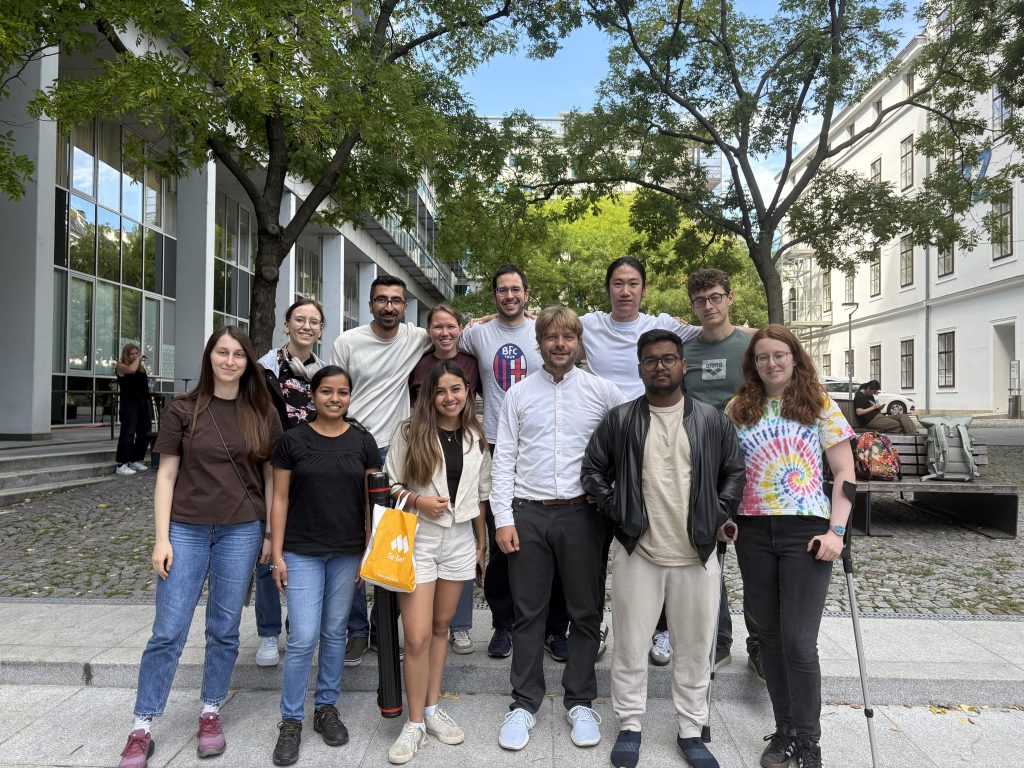
Research group of Prof. Christopher Stein (front, third from right) together with Dr Elena Kolodzeiski (back, third from left), Siyavash Moradi (back, second from left), Nicola Bogo (back, fourth from left) and Lisa Hetzel (front, right). (Photo: private)
The year begins with a number of outstanding achievements by early-career researchers from the group of Christopher Stein, Professor of Theoretical Chemistry at TUM: the awards and grants highlight the scientific excellence and international visibility of the team.
Dr. Elena Kolodzeiski, a former postdoctoral researcher in the group, has been awarded a Liebig Fellowship by the German Chemical Industry Fund (Verband der Chemischen Industrie). With this prestigious funding, she will establish her own research group – a significant step toward scientific independence.
Nicola Bogo has received a Marie Curie Global Postdoctoral Fellowship, a program of the European Commission. His project in the field of density functional theory (DFT) will take him to Berkeley and Donostia–San Sebastián. The Marie Curie Fellowships are widely regarded across Europe as an excellent and highly competitive funding line.
Lisa Hetzel has been admitted to the German Academic Scholarship Foundation (Studienstiftung des deutschen Volkes) and will also receive support through the Marianne Plehn Program – two highly respected funding schemes for exceptionally talented PhD researchers. Siyavash Moradi completed his PhD thesis with the distinction magna cum laude.
The young researchers have also been successful on the international stage: Mohammad Rahbar received the award for best doctoral presentation at a CECAM workshop in Vienna.
All of these research projects are closely connected to the scientific goals of the e-conversion Cluster of Excellence. Most of the awardees were, at least temporarily, funded or supported by the cluster. Their achievements underscore how sustained support, international collaboration, and cutting-edge research within e-conversion create an environment in which early-career researchers can thrive and successfully advance their academic careers.