

It was purely by chance that Smilla and her friends stumbled upon the escape room tucked just behind the entrance of the Deutsches Museum. On a visit to Munich with their parents, they now find themselves navigating one puzzle after another—each revealing something new about sustainable energy technologies. “It’s not that easy,” the school student says. Moments earlier, a marble run helped them select the right semiconductor for artificial photosynthesis. Now they are scouring a periodic table poster, searching for the hidden code that unlocks the next challenge.
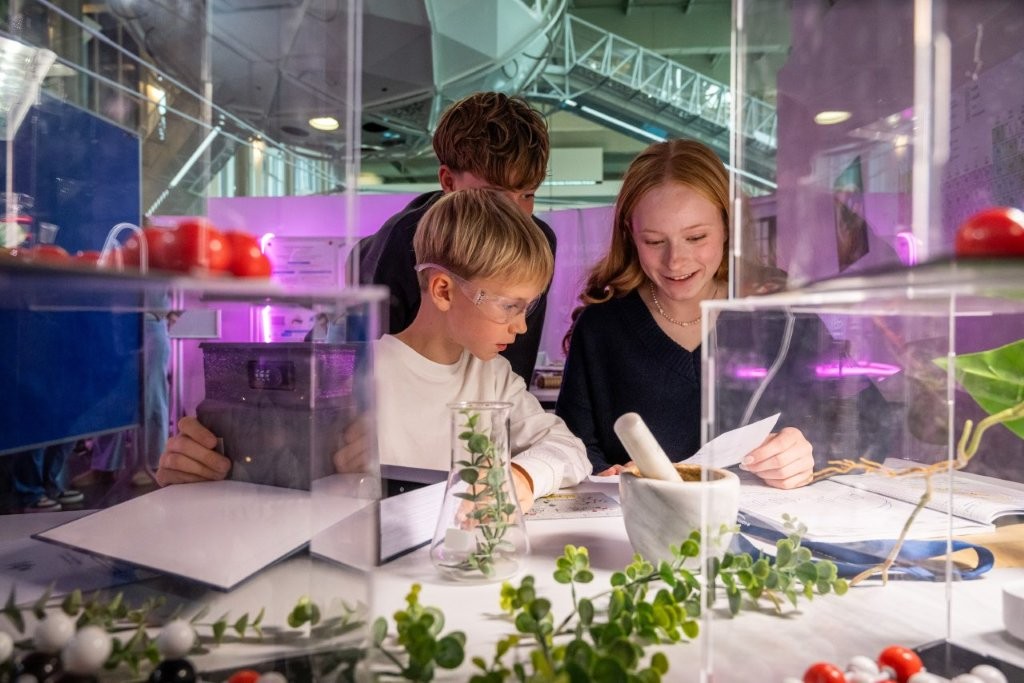
Smilla und ihre Freunde knobeln sich durch die Rätsel von „Escape from Carbonia“. (Foto: Astrid Eckert / TUM)
Like the hundreds of people who have played before them, they will solve it. The escape room is just one of the many ways in which TUM brings science into city life—not only here, at the Science Communication Lab of the Deutsches Museum, where researchers can test engagement activities directly with the public, but also at street festivals, school programs, children’s lectures, and pub talks.
Dialog with society
“We literally make science tangible and invite people into conversation” says Prof. Jeanne Rubner, Vice President for Global Communication and Public Engagement at TUM. “If we want to stay relevant as a university, we must engage in open dialogue—and reach people who otherwise have little contact with science.” This commitment is anchored in the future concept TUM Agenda 2030. It includes citizen participation in research as well as interactive, playful experiences designed to spark curiosity—whether by encouraging young people to pursue scientific careers or helping more people understand emerging technologies and their importance for society. In doing so, TUM aims to strengthen public trust in science. Many initiatives grow directly out of the creativity of TUM researchers and students. External funding, whether it comes from the state or from third parties, also places importance on more interactive forms of science communication. A quantum learning portal, a mobile cooking show on gut health—new, creative formats are emerging everywhere. Also, units like the TUM Center for Culture and Arts, the TUM Think Tank, and the Corporate Communications Center, offer creative guidance and organizational assistance.
An escape room as a pop-up lab for the street
One such project is the Escape room “Escape from Carbonia” With the idea of turning cutting-edge energy research from the e-conversion Cluster of Excellence into an immersive game, the team won the university competition of Wissenschaft im Dialog, funded by the German Federal Ministry of Research, Technology, and Space Travel as part of the 2025 Science Year “Future Energy.” “Science communication is essential,” says physics doctoral researcher Yixiao Zhang. “It gives more people insight into research that shapes all our lives—and shows how new discoveries can help us build a better world.” Zhang developed one of the game’s puzzles, using 3D models and a UV flashlight to show how catalyst surfaces influence efficient energy conversion. Experiments blend with models, audio messages, and hidden clues. Step by step, participants decode the principles behind “artificial photosynthesis”—technologies that use sunlight to trigger chemical reactions that produce hydrogen and filter CO2 from the air. Because it packs neatly into transportable crates, the pop-up escape room has appeared at numerous festivals and events across Munich. It continues to be available at the Garching e-conversion’s school laboratory.

The team behind Escape from Carbonia

The PhD students Nina Miller and...
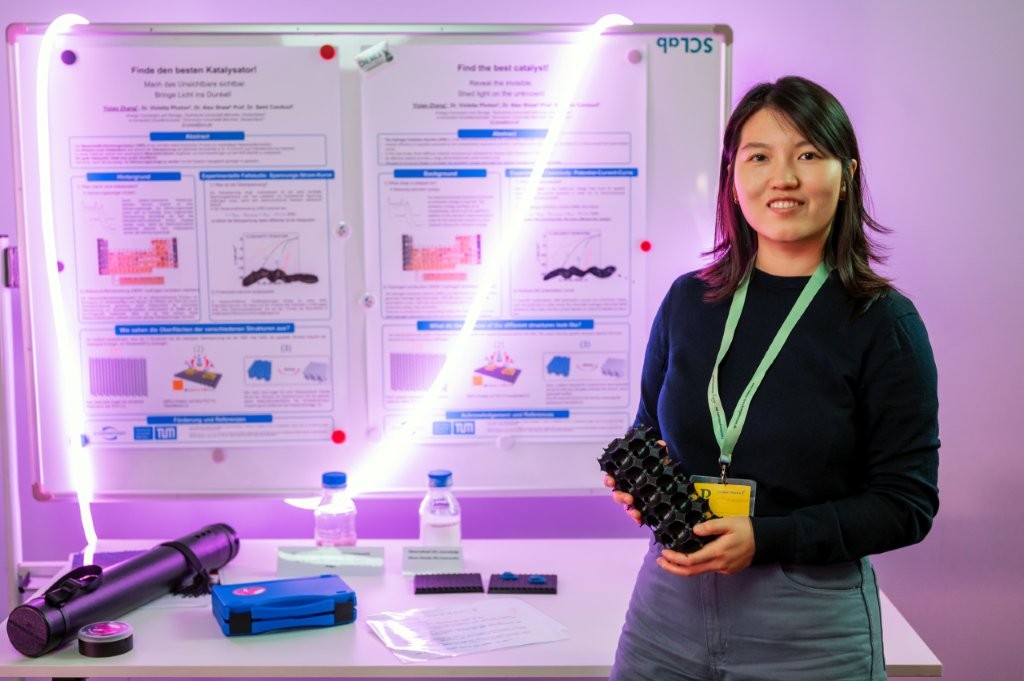
Yixiao Zhang developed a puzzle. (Photos: A. Eckert/TUM)
Chatbots on stage
Such playful, interactive formats not only make science more accessible—they also give researchers a window into public attitudes, hopes, and concerns about new technologies. Artificial intelligence is one of many examples. As part of the research project “MoralPLai” the Institute for Ethics in Artificial Intelligence (IEAI) explored the ethical and emotional challenges raised by chatbots and generative AI—through a theater production. “The Third Voice” is a research-based performance shaped by expert interviews. Set in a hospital, a courtroom, and a family home, it follows a doctor who consults an AI chatbot while treating a terminally ill patient, and her teenage daughter, who turns to the same system for motional support. The intertwined narratives invite audiences to take a hard look at AI chatbots, to reflect on whether they can be used responsibly, and if yes, how it can be done. They also reveal how such systems can both support and undermine human ethical decision-making. At the premiere at Munich’s Amerikahaus, the audience took on an active role: they were asked to determine which character bore responsibility—or guilt—for the (ir)responsible development and use of the chatbot. The question carried through the evening’s panel discussion, Q&A session, and private conversations. Audience insights into expectations for AI chatbot design now feed directly intothe Moral PLai research project at the IEAI, which aims to promote a human-centered development of AI chatbots.
Movement, rhythm, and shared physical expression
Using artistic expression to experience science and technology is an approach that is also pursued by ‘TUM tanzt!” (TUM is dancing!). It brings research into the city through movement, rhythm, and shared physical expression. “Dance is a powerful way to express yourself and connect with yourself and others,” says Lisa Lugo, who teaches Applied Sports Science at the TUM School of Medicine and Health. Together with her colleague Tina Schwender and the TUM Center for Culture and Arts, she eveloped a week-long Community Dance project. Students from across disciplines grew into a dance company within days and performed their choreography at the 2025 Munich Kunstareal Festival in the rotunda of the Pinakothek der Moderne. Other workshops and performances explored themes such as responsibility, community, human–machine interaction, and the physical experience of movement and health—engaging audiences both young and old.
Further information and links
MINTopolis youth research center
Inspiring passion for and building skills in STEM subjects—that is the goal of the MINTopolis youth research center in Miesbach. Officially opened in fall 2025, it offers courses for school classes as well as opportunities for children and teenagers to carry out their own projects. Scientific oversight is provided by TUM. MINTopolis is supported by the Stiftung Schülerforschungszentrum Oberland and the Bavarian State Ministry of Education and Cultural Affairs.
www.mintopolis.de
Experience science up close
At TUM, there are a variety of offers and programs – whether in experiments for children and young people, in discussions with our researchers or in participatory research projects.
TUM Corporate Communications Center
Kolja Kröger
engage@tum.de
presse@tum.de
Teamwebsite
Original article: https://www.tum.de/en/news-and-events/all-news/press-releases/details/bringing-the-university-into-the-heart-of-the-city