

We are honored to announce that Prof. Dr. Bettina V. Lotsch, Director at the Max Planck Institute for Solid State Research and head of the Department of Nanochemistry, has been elected as a member of the German National Academy of Sciences Leopoldina. She will enrich the Chemistry Section with her outstanding specialist knowledge. The Leopoldina is known for its role in promoting science for the benefit of society. Including Prof. Lotsch in the circle of honorees underlines her significant influence in her scientific field.
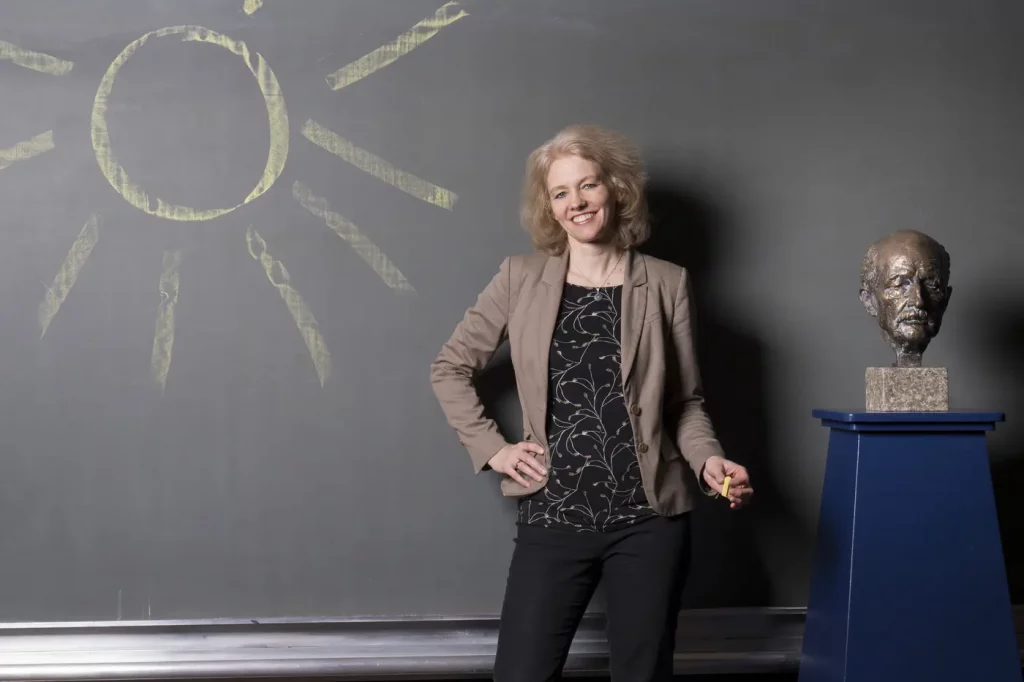
Prof. Bettina V. Lotsch (Photo: © MPI FKF)
Professor Bettina V. Lotsch is a leading materials scientist whose research focuses on developing advanced materials for sustainable energy technologies and future information systems. Since 2017, she has been Director of the Department of Nanochemistry at the Max Planck Institute for Solid State Research and an Honorary Professor at Ludwig Maximilian University of Munich. She is also an Adjunct Professor at the University of Stuttgart and, since 2024, Co-founder and Co-Director of the SolBat Center.
The main areas of her research are focused on molecular and porous materials, including metal-organic frameworks (MOFs), a field honored with the 2025 Nobel Prize in Chemistry, covalent organic frameworks (COFs), carbon nitrides, and other two-dimensional materials. This field of research is has driven a large portion of the eff Her team has demonstrated how these highly ordered materials can efficiently absorb sunlight, separate electrical charges, and catalyse chemical reactions, enabling applications such as artificial photosynthesis and solar-fuel production. She has also pioneered approaches that combine energy conversion and storage within a single material, creating systems capable of capturing solar energy and releasing it on demand. In addition, her contributions have helped establish the field of optoionics, which merges optical and ionic processes in solids and offers promising applications in energy conversion, sensing, data storage, and neuromorphic computing. Through these achievements, Prof. Dr. Bettina V. Lotsch has helped lay the foundations for next-generation sustainable energy and information technologies.
The Leopoldina
The German National Academy of Sciences Leopoldina, founded in 1652, is a traditional learned society with approximately 1,700 members representing nearly all scientific disciplines. It promotes German science internationally and develops independent expert opinions on socially relevant topics for policymakers and the public.