

Many technologies that shape our everyday lives trace back to basic research whose practical benefits no one could foresee at first. Laser physics, for example, led to a wide range of applications, including in medicine and biotechnology, and quantum mechanics is now found in every computer chip. At the Garching campus, the Technical University of Munich (TUM) has now opened a new laboratory building where researchers from physics and the biosciences work under one roof.
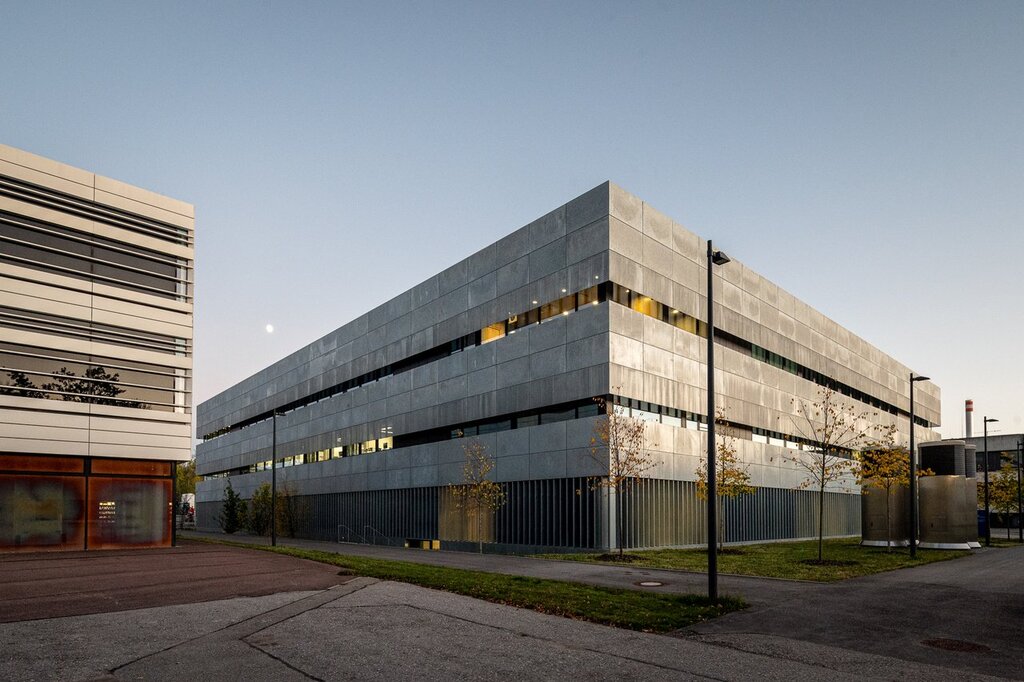
The new research building for physics and the life sciences at the TUM Garching Campus. (Photo: A. Eckert/TUM)
The Free State of Bavaria financed the new building. Science Minister Markus Blume said at the official opening: “Arguably Germany’s most excellent building: five of TUM’s seven clusters of excellence have docked in the brand-new physics building of the Technical University of Munich – a record that reinforces TUM’s standing as the best university in the European Union. Here, we have invested more than 87 million euros in Bavaria’s most modern laboratory for research into the laws of nature. From the Big Bang to the magnetic field of the Sun – everything comes under close scrutiny here; the invisible is made visible here. The new building is the Fort Knox of physics: a true purpose-built facility with 44 laboratories and 18 measurement rooms – and perhaps the incubator for the next Bavarian Nobel laureates.”
TUM President Thomas F. Hofmann said: “Genuine innovations rarely come about by a direct route. They are often based on the insights of researchers who are free to ask fundamental questions without already having to keep applications in mind. That requires freedom and high-performance infrastructure. With this new building, the Free State is investing in precisely these conditions. For that, I would like to thank State Minister Blume most warmly. The TUM School of Natural Sciences is one of the foundations on which TUM’s innovative strength and scientific excellence are rooted.”
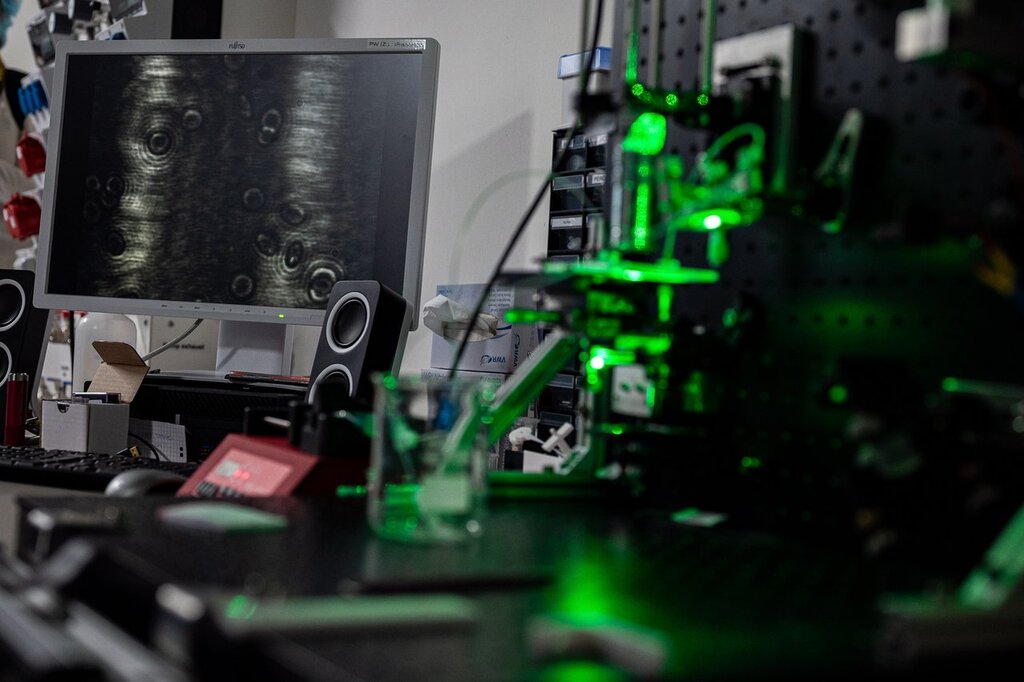
A laboratory in the new research building. (Photo: A. Eckert/TUM)
Labs That Adapt to Research
Research priorities often change faster than buildings can be planned and built. The new building therefore relies on standardization: the upper floors house 44 identically equipped laboratories. They are primarily designed for common physics experiments, but can also be adapted for special projects and bioscientific purposes. The space is allocated flexibly to professorships and junior research groups. In addition, there are 18 measurement rooms for requirements that go beyond that standard. The basement level houses, among other things, eight vibration-isolated laser laboratories as well as four laboratories for cryostats up to 7.4 meters in height. Laboratories for optical experiments, which are particularly sensitive to vibrations and temperature fluctuations, are housed in a separate structure that is isolated from the rest of the building. Modern offices and seminar rooms round out the facilities.
Five Clusters of Excellence Under One Roof
Researchers from five of TUM’s seven clusters of excellence work in the new building: BioSysteM, e-conversion, MCQST, NUCLEATE, and ORIGINS. The topics range from quantum and energy technologies through new materials to biotechnology and biomedicine. Teaching also benefits: the laboratories are available for practical training as well as for bachelor’s, master’s, and doctoral theses. Dean Prof. Johannes Barth said: “Physics and the biosciences are drawing ever closer together on many questions. In the new building, researchers from five clusters of excellence work next door to one another. It is precisely this daily exchange across disciplinary boundaries that is often the starting point for new ideas. And our students learn in the very place where new knowledge is created.”
Further information
About the building:
- Construction time: five years
- Floor space: approximately 13,100 square meters of gross floor area, including 6,478 square meters of usable floor area
- Facilities: 44 standard laboratories, 18 special measurement rooms, and a total of 80 offices and 5 seminar rooms
- Design: the attractive façade of hot-dip galvanized steel contributes to the temperature stability in the laboratories. Inside, exposed concrete and birch wood define the look.
Links:
Technical University Munich
Corporate Communications Center
- Ulrich Meyer
- presse@tum.de
- Teamwebsite
Original article: https://www.tum.de/en/news-and-events/all-news/press-releases/details/more-space-for-basic-research