

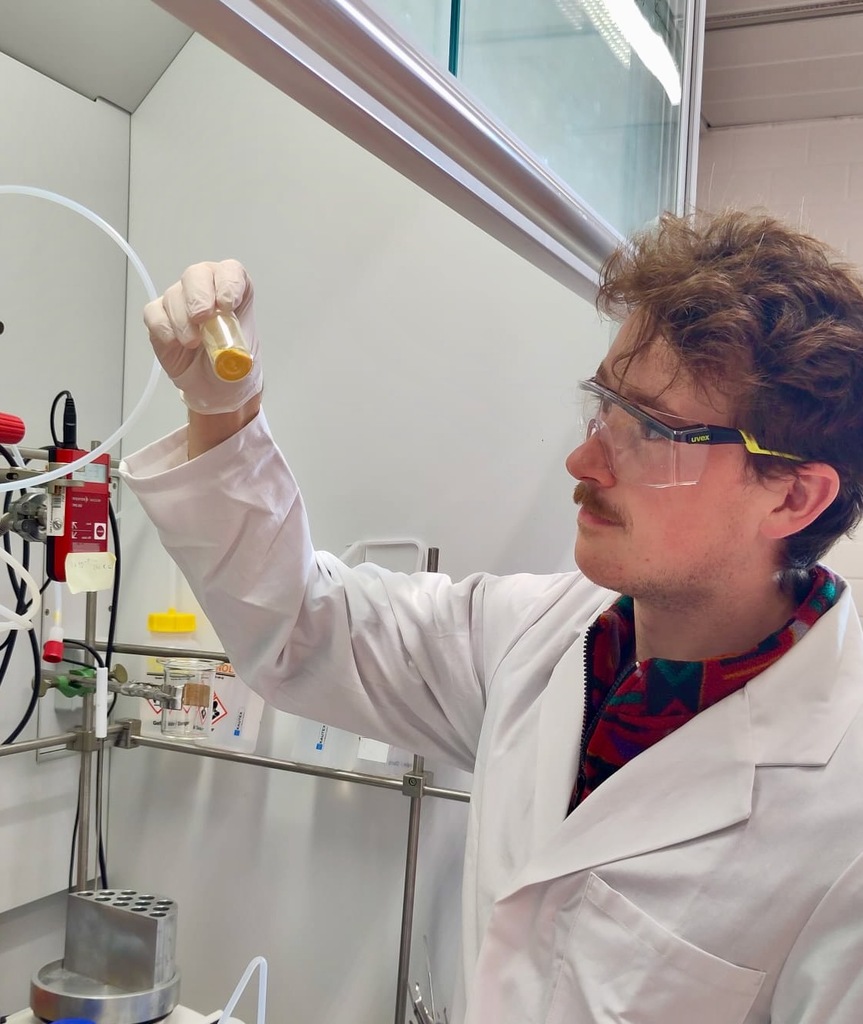
When less is more: Modifying and thereby improving catalysts is a balancing act. Sam van Gele, a doctoral student in Prof. Bettina V. Lotsch’s team at the MPI for Solid State Research, is investigating this using promising candidates: covalent organic frameworks, or COFs. (Photo: MPI FKF)
What do a house and a high-tech catalyst have in common? Both rely on a supporting framework that must remain stable even as new functions are added. This balancing act is at the heart of a recent publication on covalent organic frameworks (COFs), a promising class of materials for catalytic applications such as solar hydrogen production or the conversion of CO2 into carbon monoxide, a staple for the chemical industry.
“Our central research question is simple and complex at the same time,” says Samuel Van Gele, a doctoral researcher in the group of Prof. Bettina V. Lotsch at the Max Planck Institute for Solid State Research in Stuttgart. “How many structural and chemical changes can a catalyst withstand before its performance begins to suffer?” The study, recently published in Chemistry of Materials (ACS), shows that while chemical modifications can introduce new functionalities and improve catalytic performance, they can also alter the very foundation of the material itself.
How much change can a catalyst tolerate?
What makes COFs particularly attractive for catalysis is their crystalline, porous structure: an ordered network of tiny cavities. In addition, COFs can be tailored for different applications through targeted chemical modifications. “The challenge, however, is that every chemical modification can affect the material as a whole. Changing a single parameter means intervening in a complex network, where, for example, changes in the local pore chemistry can have unexpected consequences for the crystal lattice,” explains Prof. Bettina Lotsch. Returning to the house analogy, a new window may bring in more light and a wall opening may create larger rooms, but both can also affect the building’s structural integrity. Adding to the challenge is the fact that COFs are still a relatively young class of materials, and many fundamental questions about their behavior under catalytic conditions remain unanswered.
This is precisely the knowledge gap that the new study addresses, which was supported by the e-conversion Cluster of Excellence. Using the model electrocatalyst COF-366-Co, the researchers investigated how post-synthetic chemical modifications affect both the local chemical environment and the underlying crystal lattice. Their findings reveal that the relationship between modification and performance is more complex than previously assumed.
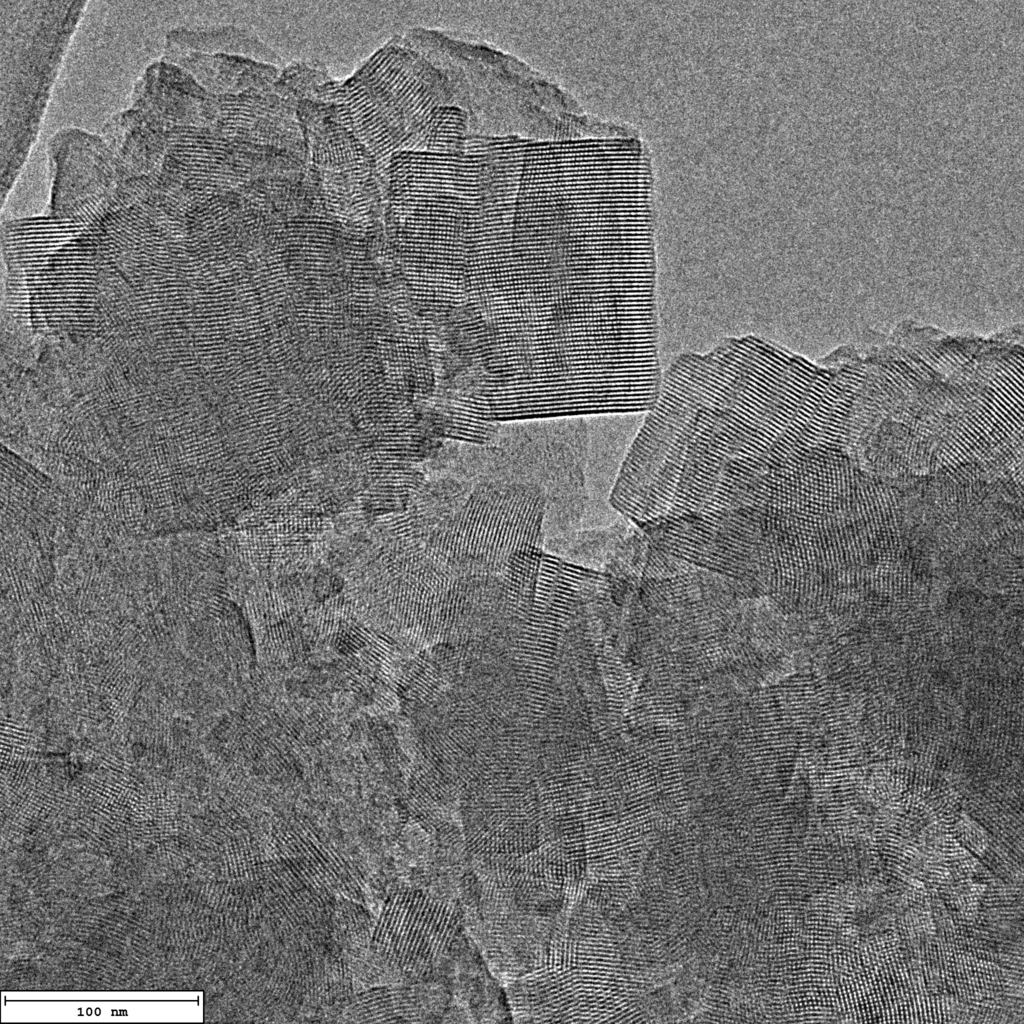
Focus on molecular frameworks: An image taken with a transmission electron microscope shows the nanopores of the COFs. (Image: Viola Duppel)
Adjusting the chemistry while preserving crystallinity
Some of the most valuable insights emerged when the experiments did not produce the expected results, recalls Samuel Van Gele, lead author of the study: “Digging deeper and understanding why the chemical modifications didn’t bring out the outcome we expected in catalysis was frustrating at first but ended up helping us understand the materials better.” A closer analysis revealed why some of the chemical modifications failed to improve catalytic performance as expected: the changes also affected the structure of the material itself. While small modifications preserved the crystalline framework and improved catalyst stability, more extensive changes introduced increasing structural disorder and reduced performance.
One of the study’s key findings is that new functionalities can be introduced without compromising the crystallinity of the material, but only up to a certain point. “Our results show that post-synthetic modifications of COFs can fundamentally reshape the framework rather than simply decorating an otherwise unchanged support material,” explains Samuel Van Gele. Through crystallographic measurements, the researchers were able to observe whether and to what extent the structure of the material changed during the modification process.
A new perspective on a young materials class
The study highlights an important lesson: to optimize the performance of COFs, function and structure must be considered together. Despite their remarkable tunability, these materials can be surprisingly sensitive to excessive modifications. “It is fascinating to gain new insights into this still very young class of materials and, in doing so, further improve their applications,” says Bettina V. Lotsch. “The results provide important guidance and early design rules for the development of future COF catalysts.” Moderate chemical adjustments can enhance catalytic properties, whereas more extensive modifications may disrupt the material’s ordered structure and impair its performance. Structural changes therefore need to be evaluated holistically, as electronic, geometric, structural, and mass-transport properties are closely interconnected and jointly determine catalytic activity. The key lies in finding the right balance.
Publication:
Deconvoluting the Convoluted: Structural Ramifications of Postsynthetic Linkage Modification in COF-366-Co Catalysts; S. Van Gele, A. Heilmaier, F. Heck, K. Küster, A. Schulz, A. Shevchenko, L. Yao, B.V. Lotsch
https://doi.org/10.1021/acs.chemmater.6c01374
Contact:
Prof. Bettina V. Lotsch
Nanochemistry Department
Max Planck Institute for Solid State Research
E-Mail: b.lotsch@fkf.mpg.de
Website: https://www.fkf.mpg.de/lotsch