

From engineering and mathematics to theoretical physics and chemistry, Dr. Mohammad Rahbar’s academic journey has taken him across several disciplines. What connects these different fields is his interest in the questions they raise. Now a postdoctoral researcher in the group of Prof. Christopher J. Stein (Theoretical Chemistry at the TUM School of Natural Sciences), who is also a member of the e-conversion cluster of excellence, he is exploring a fundamental problem: How much do we really need to know about a complex system to understand it?
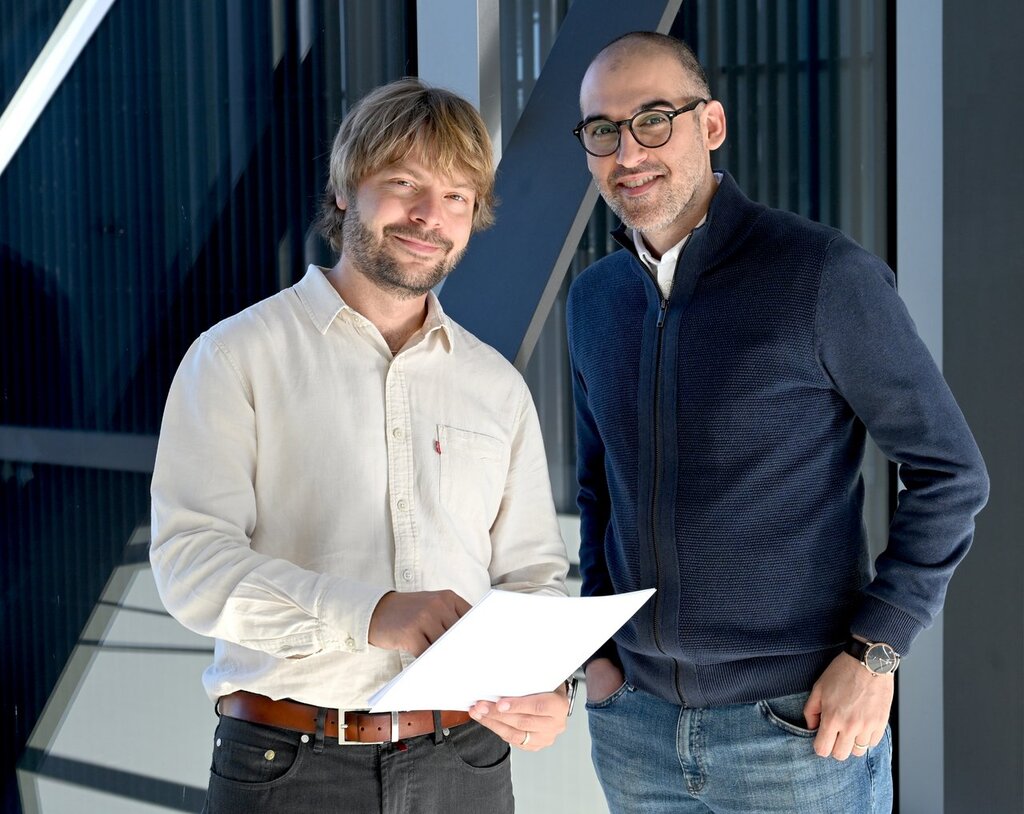
Prof. Christopher J. Stein and Dr. Mohammad Rahbar meet on the bridge connecting the Chemistry building with the TUM Catalysis Research Center. (Photo: Dr. Robert Reich / TUM)
Consider a single molecule in a liquid. Its surroundings are constantly interacting with it, influencing its behavior in ways that can be difficult to predict. Tracking every microscopic detail would quickly become impractical. But is it really necessary to know everything? The more interesting question is whether we can identify the information that truly matters, without having to describe the entire environment.
In two recent studies published in Physical Review E and The Journal of Chemical Physics, Rahbar and Stein approach this challenge from complementary directions. The first article examines how free-energy differences can be estimated under strong system–environment coupling while assessing whether the available statistical information is sufficient for the calculation to be reliable. The second article reveals how molecular correlations determine the statistical properties of interaction energy. Together, they show why the relationship between a system and its environment is central to understanding molecular behavior.
For Rahbar, the papers also mark an important stage in his scientific development. The questions behind them emerged during his doctorate and gradually opened the way to broader problems in statistical physics. As he puts it: “Complexity leaves clues. We do not need to know everything. We need to learn which clues are enough.”
Drawing a boundary that nature does not see
In theoretical science, it is often useful to divide the world into two parts: the system we want to study and everything around it, which we call the environment. This distinction makes complex problems easier to handle mathematically. But the physical world does not necessarily respect it. “The molecule doesn’t know what the boundary we are defining,” Rahbar said during the interview. Interactions between the system and its surroundings continue regardless of where we draw the dividing line. This raises a fundamental question: Can we describe a system accurately without overlooking its interactions with the environment? The problem becomes particularly interesting when these interactions are strong. Rather than trying to eliminate the system–environment interaction, Rahbar and Stein began asking what could be learned by studying it statistically
One result of this work is their Physical Review E paper, “Endpoint reweighting identities with overlap diagnostics for free-energy differences in strongly coupled open systems”, published in in July 2026. The coauthors develop a framework for calculating free-energy differences between equilibrium states while explicitly accounting for statistical overlap. Their numerical tests show that the overlap factor can be reconstructed from the same samples used by the estimator. This makes it possible to assess a key source of uncertainty directly, rather than treating it as a hidden limitation of the calculation. For Rahbar, the project highlighted an important distinction between mathematical correctness and practical applicability. “Learning that an exact answer is not necessarily an accessible answer” was one of its hardest lessons, he says. An equation can be perfectly correct, yet extremely difficult to evaluate reliably on a computer if the relevant events are too rare to appear often enough in a simulation. In other words, deriving an exact result is only part of the problem. One must also ask whether the available data contains enough information to make use of it.
From molecular structure to thermodynamics
Their second publication approaches the system-environment relationship from a different perspective. In “Interaction-energy statistics from structural correlations”, published in The Journal of Chemical Physics in September 2026, Rahbar and Stein investigate how the interaction energy between a system and its environment is related to molecular structure. They derive expressions connecting the mean and variance of the interaction energy to structural information and test their theoretical framework using Monte Carlo simulations of a Lennard-Jones system. In doing so, they establish a link between microscopic structural correlations, interaction-energy statistics, and thermodynamic quantities.
The underlying idea is that the arrangement of molecules around a system contains information about how strongly they interact with it. This was one of the more interesting findings for Rahbar. “At first, it looked like the source of difficulty: something that made the system harder to describe,” he says. “But later we realized that the interaction with the environment was also carrying useful information about the molecular structure around the system.” This shifted the question toward identifying which features of the surrounding molecular structure carry the information needed for the quantities that they want to predict. More broadly, the study shows that molecular structure and energetics are not separate descriptions of a molecular environment. It helps clarify which features of a complex environment are actually needed to describe its influence on the system.
A research path without straight lines
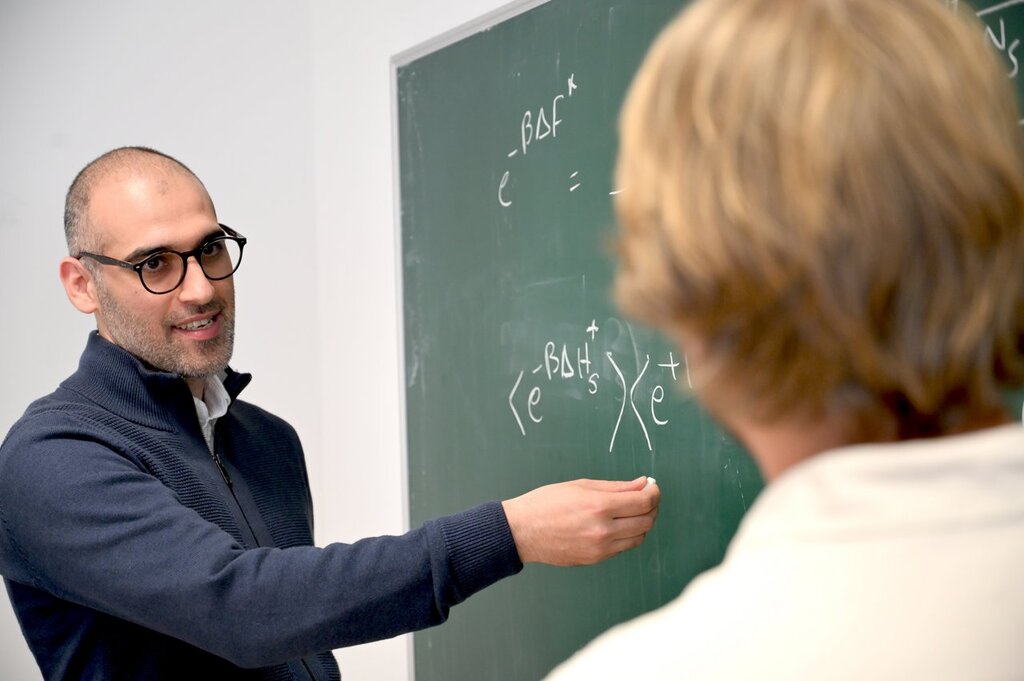
Dr. Mohammad Rahbar (left) and Prof. Christopher J. Stein (right) talk through some of the concepts developed in their research at the blackboard in Stein’s office in Chemistry at TUM School of Natural Sciences. (Photo: Dr. Robert Reich / TUM)
Rahbar’s route into theoretical chemistry was far from conventional. He initially studied engineering, drawn particularly to mathematical ideas underlying engineering problems. His interest in mathematics grew, and he eventually found himself looking for questions that went beyond the scope of his original discipline. He continued his studies in mathematical engineering at the University of Padua, Italy, where elective courses in theoretical physics introduced him to statistical physics. It was a turning point. “What I was wishing to do is exactly statistical physics, but I wasn’t aware of such a field,” he recalls.
His academic path eventually brought him to Prof. Stein. Stein remembers being impressed by Rahbar’s master’s thesis. Although his background was somewhat unusual for the position, the subject was closely related to Stein’s own previous research. The quality of the work convinced him that Rahbar was a strong candidate for the doctoral position. The initial PhD project had a relatively straightforward objective: find a better microsolvation model. “We still don’t have that model,” Stein joked during the interview. What began as a specific research problem gradually developed into something broader. The work led them to questions about the statistical and thermodynamic relationships between a system and its environment, and about how these relationships can be described mathematically. For Rahbar, this development was particularly important. A question he had initially assumed might already have a well-established answer turned into a research direction he could imagine pursuing long after completing his doctorate.
The freedom to find a question
The collaboration with Stein plays an important role in that process. Rahbar describes having considerable freedom to explore his own ideas, while also learning to examine them more critically. What exactly has been demonstrated? Which assumptions are necessary? And where does a mathematical result end and its physical interpretation begin? Stein, for his part, recognized that Rahbar benefited from having room to develop his own ideas. Their collaboration involved many discussions, but also a degree of intellectual independence that Stein particularly valued.
That independence did not mean avoiding criticism. Rather, it made their exchanges more productive. “What I valued most was that he took my ideas seriously enough to challenge them,” Rahbar says. “He did not tell me what to think. He helped me become more demanding about how I think.” They also had to find a common language. Rahbar brought experience in engineering, mathematics, and physics, while Stein approached the problems from theoretical physics and chemistry. Translating between these perspectives was one of the challenges in the early stages of their collaboration. Over time, however, the ability to formulate and communicate mathematically demanding ideas across disciplinary boundaries became one of its strengths.
From solving a problem to defining a new research line
As a postdoctoral researcher, Rahbar is now interested in a broader question: how one level of a physical system reveals another, and which information survives when a complex description is reduced. He hopes to develop this into an independent research program that brings prediction, reliability, and physical interpretation into the same framework. This perspective naturally extends from equilibrium molecular systems toward more realistic molecular environments, nonequilibrium dynamics, and, eventually, quantum open systems. Stein says he sees considerable potential in this direction. Questions surrounding information, system–environment interactions, and the boundaries between different levels of description connect several areas of statistical physics and molecular science, while leaving room for Rahbar to develop his own scientific perspective. For Rahbar, this is what made the doctorate worthwhile in the first place. “I did it in order to really come up with a better question,” he says.
That attitude also shapes his advice to students. Drawing from his own experience across several disciplines, he encourages young researchers not to become too attached to the boundaries of their academic field. “Do not become too loyal to the name of your discipline. Be loyal to good questions.” Each field has given him a different perspective: engineering taught him the value of approximation, mathematics helped him recognize structure, physics encouraged him to look for general principles, and chemistry taught him to respect complexity. “Fields have names,” he concludes. “Nature does not.”
Publications
- Mohammad Rahbar and Christopher J. Stein. Interaction-energy statistics from structural correlations, The Journal of Chemical Physics (2026), https://doi.org/10.1063/5.0352043
- Mohammad Rahbar and Christopher J. Stein. Endpoint reweighting identities with overlap diagnostics for free-energy differences in strongly coupled open systems, Physical Review E (2026), https://doi.org/10.1103/3twj-4279
More information and links
Link to the original publication