

The future of energy is renewable. What the exact mix of solar, wind, and hydropower will look like remains uncertain. What is clear, however, is that these energy sources must be efficiently convertible into one another. For a renewable energy mix to work, reliable storage systems are essential – and batteries and fuel cells play a central role. This is precisely where the interdisciplinary scientists of e-conversion come in. At the TUM School of Engineering and Design, researcher Prof. Jan Torgersen optimizes energy materials using high-resolution 3D printing and thin-film technology with nanometer precision.
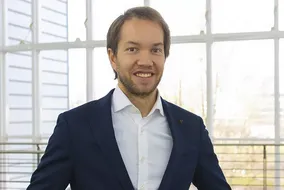
"I often think about our research from the perspective of the component," says Prof. Jan Torgersen, who heads the Chair of Materials Science at the TUM School of Engineering and Design. (Photo: Susanne Höcht/TUM)
Professor Torgersen, you have been at TUM since 2022. How does your role here and in the e-conversion Cluster fit into your previous career path?
It all started at TU Vienna, where I discovered my passion for materials science. Back then, I was particularly interested in new materials and manufacturing methods. During my PhD, for example, I worked intensively on high-resolution light-based 3D printing processes and biomaterials. A key step in my career was my time at Stanford University, where I first engaged deeply with the topic of energy conversion and increasingly focused on materials for energy conversion and storage – such as solar cells, catalytic layers, and nanofabrication. My research at the Nanoscale Prototyping Laboratory was especially exciting, as I am very interested in the interaction between the nano- and mesoscale. I later expanded this combination of materials science and energy topics at the Norwegian University of Science and Technology – and that is exactly the perspective I now bring to TUM and e-conversion.
What does this "engineering perspective" mean in concrete terms for your research in the cluster?
We often think about our research starting from the component. In e-conversion, there is a lot of excellent work at the atomic or molecular level, but my approach is: how can this ultimately be turned into a functioning system? I am interested not only in the material itself, but also in questions such as: How do certain phenomena or effects scale? Do they provide a performance advantage? Can we develop a component that works in practice? This bridge between fundamental research and application is exactly the space I am most interested in.
What are your main current research focuses in materials science?
We develop materials that convert or store energy, such as fuel cells, electrolyzers, or batteries. A key focus is on electrodes, where reactions and charge transfer occur. I brought a very exciting ERC (European Research Council) project from Norway to TUM. It investigates the transport of fuels and reaction products within electrodes. The fuel should be distributed homogeneously across the catalyst layer, and the products should be efficiently removed from it. What is new about our approach is that we optimize the electrodes geometrically to achieve specific transport properties. These electrodes consist of complex structures with channels, pores, and catalyst particles. This is where the challenge lies: with conventional manufacturing methods, the geometry is difficult to control. We therefore aim to design electrode architectures on the computer and then fabricate them precisely as planned. With our method, we can create carbon and graphite structures with desired geometries across length scales from nanometers to centimeters.
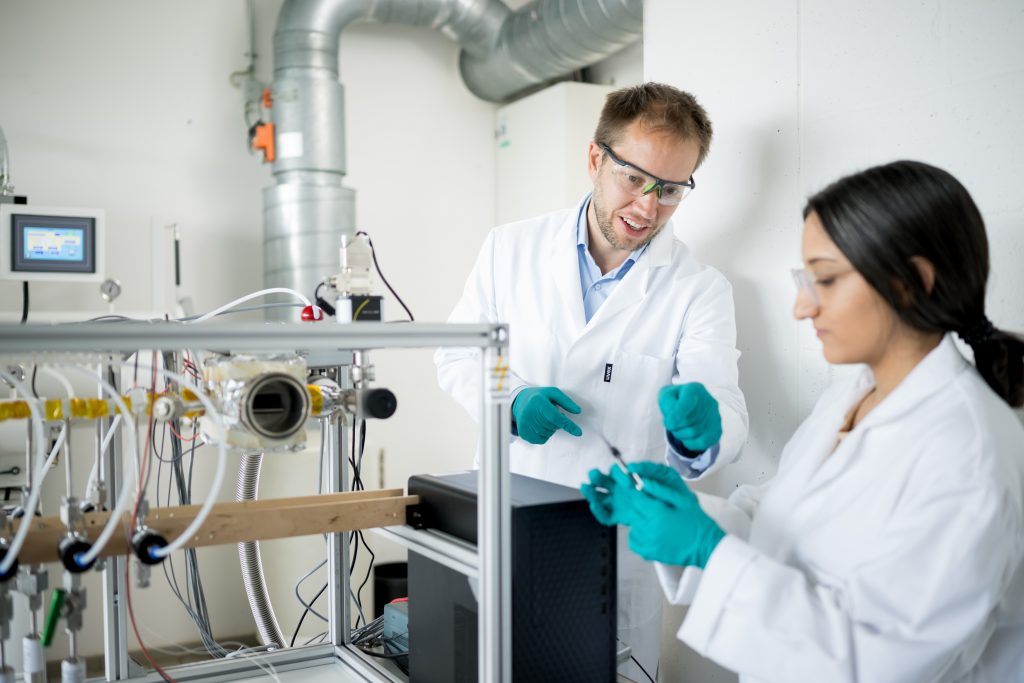
Material structures are crucial for mass transport. Jan Torgersen (left) is conducting research at the Chair of Materials Science at the Technical University of Munich (TUM) to determine how these structures can be improved. (Photo: Susanne Höcht / TUM)
Why are these structures so crucial?
Because they directly influence mass transport, which is a decisive factor in energy conversion processes. Reactants must reach the surface, react there, and the products must then be removed. Simply having a large surface area is not enough. On the contrary, products can accumulate, or reactants may not be supplied quickly enough. Our goal is to design structures so that these processes balance themselves, without additional energy input, such as pumping. A fuel cell is a good example: water is produced and must be removed, otherwise it blocks oxygen transport. We develop structures that direct this water away in a targeted manner—often inspired by natural systems such as trees.
That sounds like 3D printing at the molecular level. How does it work?
Exactly. We use a technology called two-photon lithography. It is a highly precise 3D printing method in the nano- and micrometer range. A laser is focused into a light-sensitive material that hardens only at that exact point. The trick is that instead of a single high-energy photon, two lower-energy photons are absorbed simultaneously. At the focal point, the light intensity is high enough to "write" very fine, three-dimensional structures directly inside the material and with resolution down to the nanometer scale. This allows us to create architectures such as pore and channel systems that precisely control how substances move through an electrode. Using computational fluid dynamics (CFD), we analyze and optimize geometries to fine-tune desired flow processes in detail.
You combine 3D printing with other techniques, such as atomic layer deposition. Why?
The printed structures initially only provide the shape. The function comes from materials such as metals or semiconductors. With atomic layer deposition, we can apply extremely thin, uniform coatings atomic layer by atomic layer. Catalysts such as platinum can thus be used very efficiently. Improving atomic layer deposition itself is also a research focus. The goal is always to use as little expensive or rare material as possible while still achieving high performance.
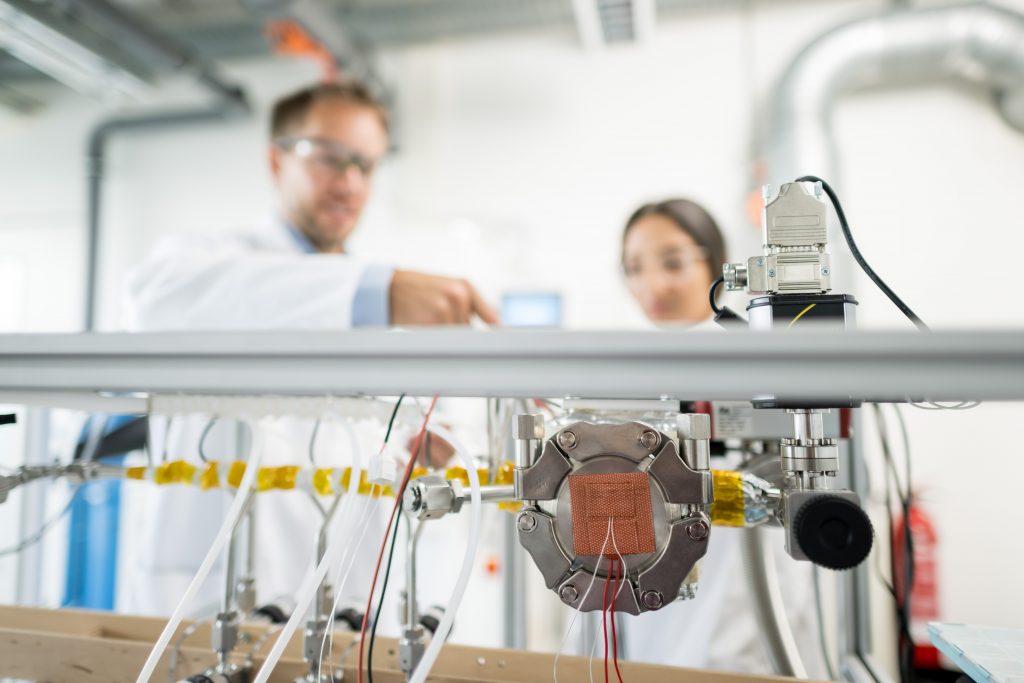
Fuel cells, electrolyzers, or batteries. A key focus of Jan Torgersen's research is on the electrodes where reactions and charge transfer take place. (Photo: Susanne Höcht / TUM)
That certainly sounds like a balancing act…
Absolutely. That is essentially the core of our work: balancing conflicting requirements. A material should be stable but also reactive. It should be conductive but also corrosion-resistant. Moreover, these properties often influence each other. For example, if I increase the surface area to enhance reactivity, I may run into problems with mass transport or stability. This means we never optimize just a single parameter, but always an entire system. This balancing act is the real challenge.
For you, research also means rethinking methods. Where does this approach come from?
It developed early on. During my dissertation, I worked extensively with two-photon lithography, and the existing systems did not always do what I needed. So I started modifying and extending them, and developing new functionalities. Ultimately, these and other developments at TU Vienna led to the founding of a startup, upNano. Advancing tools is deeply embedded in my team. This is especially crucial for energy research, as new insights often only emerge when methods themselves are further developed.
How do you experience collaboration within the e-conversion community?
Very open and interdisciplinary. Traditional disciplinary boundaries are increasingly blurring, which I see as an advantage. There are many links to my research, for example with topics such as photochemistry, metal-organic frameworks, or battery materials. As an engineer, I feel very welcome, because the perspective of orienting research more strongly toward functional systems resonates with many.
What motivates you personally? How do you recharge and find new energy?
I dedicate my research to advancing renewable energy and want to help combat climate change. We urgently need alternatives to fossil-based technologies and energy conversion systems that are efficient, scalable, and independent of scarce resources. For me, cycling is a wonderful way to keep things balanced. I also enjoy riding along the Isar on my way to work. It simply feels good. In addition, I spend a lot of time with my children and family on the weekends, or meet up with friends in the evenings. Some of them are also professors at TUM, so our conversations often turn to our research topics.
Thank you very much for the interesting interview. We wish you all the best and every success in your research at TU Munich and the e-conversion Cluster of Excellence!
Short profile
Jan Torgersen studied industrial engineering and mechanical engineering at TU Vienna, where he completed his PhD in 2013, focusing on high-resolution 3D printing processes. From 2014, he conducted research at Stanford University with a focus on nanofabrication and energy conversion. In 2016, he was appointed Associate Professor at the Norwegian University of Science and Technology (NTNU). Since 2022, he has been a professor at the Technical University of Munich, where he heads the Chair of Materials Science at the School of Engineering and Design.