

LMU researchers develop a method for quality analysis of individual nanocrystals – a key step toward reliable large-scale production
Nanocrystals are already used in millions of devices, including televisions, laptops, and displays, and are considered key materials for the next generation of quantum, sensing, and solar technologies. However, they have not yet fully realized their potential. One major reason is their inherent heterogeneity: a single solution contains billions of nanocrystals whose properties can differ substantially. Although these particles can be characterized, important quality parameters are typically only accessible as average values across the entire sample. "For their function in devices, these average values are insufficient," says Prof. Emiliano Cortés, who conducts research at LMU's Nano-Institute. "Each individual nanoparticle can behave differently – for example, in its size or in how efficiently it emits light, meaning how effectively it converts absorbed energy back into light."
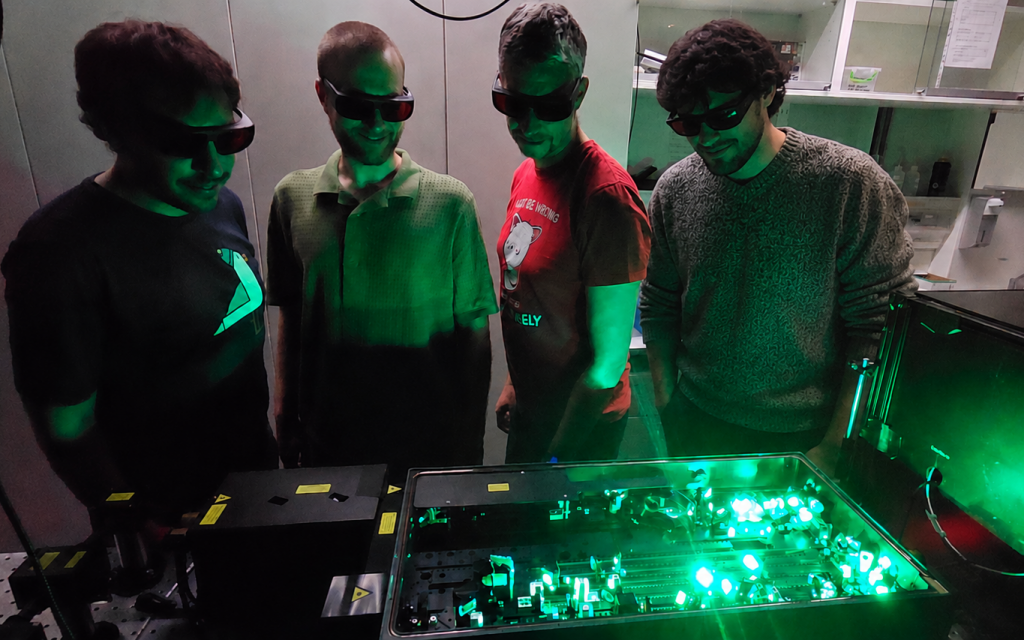
Green Light for High-Throughput Nano-Screening: The LMU team (from left: Emiliano Cortés, Christoph Gruber, Alexander Urban, Andrea Mancini) can determine the optical properties of 20-nanometer-sized particles. (Photo: C. Gruber / LMU)
A new light-based methodology
Cortés and his team show how this gap can be closed in a recent publication in the journal Nature Materials. In the study, the researchers determine the size and quantum yield of thousands of individual perovskite nanocubes directly in solution and within a short time. "We have developed a light-based high-throughput method that enables quality control at the single-particle level," explains Dr. Christoph Gruber, first author of the study. "This is crucial for the reliable production of materials and the devices built from them. Billions of nanoparticles determine the overall performance. Instead of relying on averaged values, we can now differentiate how strongly individual particles contribute and how much they vary within a sample."
A key factor in the success of the study was the close collaboration with other LMU researchers, in particular the team led by Prof. Alexander Urban. This group specializes in the synthesis of perovskite nanocrystals and produced the nanocubes used in the study. The investigated perovskite nanocubes are smaller than 20 nanometers and can differ significantly in their optical performance, even within seemingly uniform samples. Urban explains: "We can now look specifically at individual particles and identify clear trends: smaller nanocrystals, for example, show a higher quantum yield – meaning they emit light more efficiently – than larger ones. This understanding is crucial for fully exploiting the potential of perovskites for high-performance and scalable optoelectronic devices."
Nanocubes under quality control
Achieving high-throughput screening was technically demanding: thousands of particles must be measured quickly, precisely, and reproducibly. "A major challenge was handling the large volumes of data and establishing a reliable analysis pipeline," says Dr. Andrea Mancini, co-first author of the study. In addition, perovskite nanocrystals are sensitive materials: they react to intense light exposure, oxygen, or moisture, and can change during measurement. "We had to ensure that we were really measuring the original material rather than a degradation product," Cortés explains. "Achieving stable in situ measurements was a major breakthrough."
With the new method, the researchers can now systematically link the size and function of individual nanoparticles for the first time – and make this relationship useful for material development. "High-throughput quality control at the level of individual nanoparticles has not previously been possible in this form," emphasizes Gruber. "It is now possible to assess and optimize material quality even before integration into a device." The potential of the technology has also been recognized by the European Innovation Council: further development of the patented method toward practical application is being supported with an EIC Transition Grant of €2.45 million. As part of the iNSyT One project, Dr. Christoph Gruber will work to turn the technology into a market-ready product. The goal is to enable rapid and precise quality control of nanoparticles.
Publication:
High-throughput in situ sizing and quantum yield determination of individual perovskite nanocrystals; Christoph G. Gruber*, Andrea Mancini*, Nina A. Henke, Carola Lampe, Olivier Henrotte, Michael F. Lichtenegger, Franz Gröbmeyer, Andreas Singldinger, Yi Li, Stefan A. Maier, Alexander S. Urban+, Emiliano Cortés+, Nature Materials
https://doi.org/10.1038/s41563-026-02607-5
Contact:
Prof. Emiliano Cortes, NanoEnergy Group
Emiliano.Cortes@lmu.de
Prof. Alexander Urban, Nanospectroscopy Group
urban@lmu.de
Dr. Christoph Gruber, iNSyT ONE Project
ch.gruber@physik.uni-muenchen.de