

Light has many talents and plays a key role in future technologies: it can transmit information, transport energy and provide the basis for quantum applications in the form of individual photons. Gaining ever more precise control over light – to develop building blocks for optical microchips, ultra-fast communication, and new concepts in energy and information processing – is also a central goal of the Cluster of Excellence e-conversion and of the team led by LMU scientist Prof. Philip Tinnefeld.
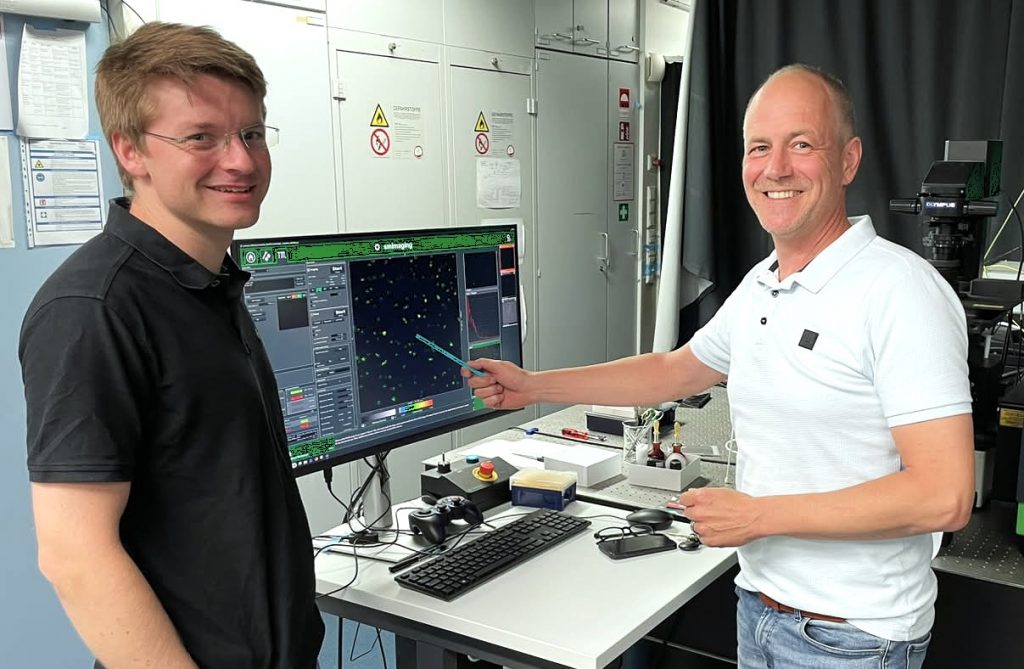
Tim Schröder (left) and Philip Tinnefeld in the lab. (Photo: Tinnefeld Lab)
In a recent publication in the journal Small Structures, the researchers show how DNA can be used as a programmable toolkit to self-assemble photonic structures at the molecular level (following a bottom-up approach) and harness them for energy transport. To date, photonic structures – typically ranging from a few hundred nanometers down to well below that scale – are mostly fabricated using lithographic methods (top-down approach). While highly precise, these approaches reach their limits below approximately 100 nanometers.
How energy behaves at the nanoscale
At the molecular level, however, light is not transmitted directly. Instead, its energy is absorbed and converted into so-called excitons – excited states that transport energy through the structure in discrete packets. The motion of these excitons lies at the heart of the study, particularly the question of what happens when multiple excitations are present at the same time. When two excitons meet, a process known as annihilation can occur, in which the energy of one exciton is dissipated as heat, leaving only a single exciton behind. “Such annihilation processes are important loss channels in photonic structures, organic semiconductors, and solar cells,” explains Philip Tinnefeld. Related processes also occur in natural photosynthetic systems, for example, when plants protect themselves from excess energy under strong illumination.
Precise nanostructures thanks to DNA Origami
“We have created a model system in which we can deliberately induce such collisions of electronic excitations and study them at the single-molecule level,” says Tinnefeld. “Advances in DNA nanotechnology over recent years now allow us to build robust, precisely defined structures. This enables us to control the conditions for annihilation and to learn how to interpret the resulting signature quantitatively.” To achieve this, the LMU researchers use DNA origami technology. DNA serves as a nanoscale scaffold on which organic dye molecules are positioned with high precision – similar to components on a circuit board. In this way, the team constructs one-dimensional energy-transport chains consisting of up to nine dye molecules.
The key feature of this energy chain: special starter molecules at both ends absorb excitation light and each injects an exciton into the chain. These energy packets then move step by step along the dye molecules toward one another. When two excitons meet in close proximity, annihilation can occur. By analogy with particle accelerators, the researchers therefore refer to their structures as “exciton colliders” on the nanoscale.
Tracking the photon fingerprint
One challenge in the analysis is that excitons cannot be observed directly. To make their dynamics visible nonetheless, the researchers analyze the emitted light and make use of a quantum property of excitons: each exciton can produce at most one photon. If two excitons are present, two photons would in principle be possible. However, if annihilation occurs, only one exciton remains to emit at most a single photon. Statistically, for every 10,000 detected photons, just one photon is missing due to an annihilation event process, and it is exactly this “missing light” that serves as a measurable indicator of exciton interactions. “We look for this fingerprint in the photon statistics to reveal annihilation processes,” explains Dr. Tim Schröder, first author and senior researcher in Tinnefeld’s team. “The challenge is to clearly identify this fingerprint despite the complex properties of the individual dye molecules. Such model systems with well-defined structures are essential for transferring our measurements and simulations to more complex systems.”
The work provides a new tool for better understanding energy losses in photonic and optoelectronic nanostructures. This is not only fundamental for the development of future light-based technologies, but also relevant for the controlled manipulation of light emission at the smallest scales – for example in photonic devices, quantum technologies, or in the study of energy-converting systems such as solar cells.
Publication:
DNA-Based Exciton Collider to Monitor Exciton Diffusion and Annihilation; Tim Schröder, Philipp Wutz, John M. Lupton, Philip Tinnefeld, Jan Vogelsang
https://doi.org/10.1002/sstr.202500889
Contact:
Prof. Philip Tinnefeld
Faculty for Chemistry and Pharmacy
Ludwig-Maximilians-Universität München
E-Mail: philip.tinnefeld@cup.lmu.de
Website: Group of Philip Tinnefeld at LMU Munich