

Solid-state lithium metal batteries are promising candidates for next-generation energy storage. Researchers at the Technical University of Munich (TUM) have now shed light on a key obstacle to their development: instability at the interface between lithium metal and the solid electrolyte, which can lead to the growth of lithium dendrites and ultimately battery failure. By investigating this hidden interface during battery operation, the team gained new insights into the factors governing battery stability.
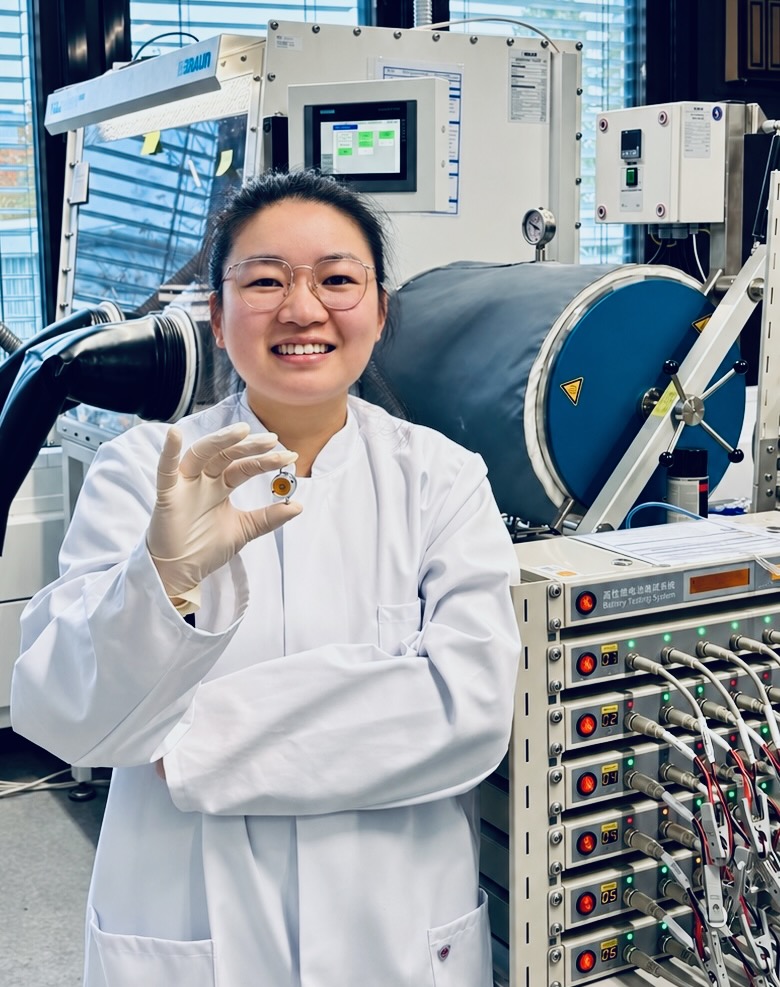
TUM researcher Yingying Yan is holding an operando cell. (Photo: Dr. Yuxin Liang / TUM)
Using operando nanofocus X-ray scattering, a team led by Prof. Peter Müller-Buschbaum tracked the evolution of the solid electrolyte interphase (SEI) and linked its spatial distribution to lithium deposition behavior. Now reported in the scientific magazine ACS Energy Letters, their findings reveal that the uniformity of this interface plays a key role in stabilizing solid-state batteries.
During charging and discharging, electrochemical reactions form a thin layer known as the solid electrolyte interphase (SEI). Acting as a gatekeeper between lithium metal and the electrolyte, it controls lithium-ion transport and influences whether lithium is deposited uniformly or accumulates locally. However, observing how the SEI develops under realistic operating conditions has remained a major challenge. Researchers at TUM, funded by the e-conversion Cluster of Excellence, have now been able to follow its evolution and relate local interphase structures directly to lithium deposition.
Tracking interphase formation during battery operation
The team found a clear relationship between the structure of the SEI and lithium deposition. “A homogeneous SEI was associated with uniform lithium growth, while uneven and discontinuous interphases coincided with localized lithium accumulation and the formation of dendrites,” said Yingying Yan, PhD candidate in Müller-Buschbaum’s team. “The results suggest that controlled lithium-ion transport promotes the formation of a robust and multifunctional SEI, which in turn supports homogeneous lithium deposition and helps suppress dendrite growth.” The study points to a strategy for improving the long-term stability of solid-state batteries: regulating ion transport to promote the formation of a robust and multifunctional SEI at the lithium/electrolyte interface.
Mapping processes at the nanoscale
To reveal these hidden processes, the researchers used operando nanofocus wide-angle X-ray scattering (nWAXS) at DESY in Hamburg. Using a highly focused X-ray beam measuring only 350 × 330 nanometers, roughly 200 times narrower than a human hair, they mapped the distribution of metallic lithium and crystalline SEI components across buried battery interfaces. “For the first time, we were able to map how important SEI components evolved across the same buried interface while the battery was operating and see how these changes affected lithium deposition,” says Prof. Peter Müller-Buschbaum. By repeatedly examining the same lithium/electrolyte interface during successive charging and discharging cycles, the researchers followed the evolution of key SEI components, including LiF and Li₃N, and related these changes directly to lithium deposition behavior. The study demonstrates how operando measurements can provide an unprecedented view of buried solid-state battery interfaces, revealing how interphase formation and lithium deposition evolve together during operation. “These insights open new pathways toward safer and longer-lasting solid-state lithium metal batteries,” concludes Peter Müller-Buschbaum.
Publication:
Y. Yan, L. Liu, Y. Liang, F. A.C. Apfelbeck, L. Cheng, G. Pan, D. Lei, L. Li, T. Zheng, Z. Xu, L. Xia, C. Yuan, L. Zhang, Y. Cheng, A. Davydok, C. Krywka, R. A. Fischer, P. Müller-Buschbaum: Mapping Solid Electrolyte Interphase Evolution and Lithium Deposition at Solid-State Interfaces by Operando Nano-focus WAXS; ACS Energy Letters (2026)
DOI: https://doi.org/10.1021/acsenergylett.6c01817
Contact:
Prof. Dr. Peter Müller-Buschbaum
TUM School of Natural Sciences
Chair of Functional Materials
E-Mail: muellerb@ph.tum.de
Website: www.ph.nat.tum.de/en/functmat/about-us/