


Surprisingly dark: Although they are ultra-thin, the perovskite layers appear strikingly black. (Photo: © LMU / Johanna Weber)
The highly advanced layers are only a few hundred nanometers thick—yet they are clearly visible to the naked eye. This ultrathin film appears strikingly dark as it captures a large portion of the incident light. The material we’re talking about is perovskite – a class of crystalline materials that is well suited for ultra-thin solar cell applications. “In solar cells, our thin film components are generally less than two micrometers thick,” explains Dr. Erkan Aydin, head of the LMU research group for innovative photovoltaic technologies.
Working with his team, he is developing perovskite solar cells that are suitable for many different applications, such as facades, wearables or even satellites. Perovskite materials absorb sunlight very efficiently and can be applied to a wide range of surfaces, including metal foils, plastic films and glass. For example, because of their ultra-thin and sometimes even transparent structure, the perovskite cells could be integrated into window glass or be applied as films. Because they can be processed by relatively simple and low-cost methods such as printing or coating, perovskites offer a highly versatile platform for future solar technologies. “All these properties make perovskites a unique material platform,” says Dr. Esma Ugur, head of the LMU research group for fundamental studies of energy-harvesting technologies. However, further work is needed to improve stability and long-term reliability before the technology can be used more broadly.
Efficient energy generation and quantum technologies of the future
Aydin, Ugur and other researchers at LMU are keen to bridge this gap between basic research and industrial application. To help them keep developing the perovskite modules, they are receiving support from the German Research Foundation, which funds the e-conversion Cluster of Excellence . As part of this initiative, scientists from LMU and TUM are working with other partners to investigate how energy can be converted and stored more efficiently and sustainably. Aydin’s main focus is on the basic principles: “We’re primarily developing fundamental materials and device principles needed to solve challenges that industry cannot yet address.”

A unique material platform: Through their research, Esma Ugur and Erkan Aydin aim to improve the stability and reliability of perovskite solar cells. (Photo: © LMU / Johanna Weber)
LMU researcher Dr. Quinten Akkerman, leader of the Quantum Dot Synthesis and Characterization research group at the Nano-Institute Munich, is also working on fundamental aspects of perovskites. He is experimenting with perovskite crystals that are just a few nanometers in size – an order of magnitude in which quantum mechanical properties manifest themselves. In the technical jargon, objects like this are referred to as perovskite quantum dots. With their exceptional optical properties, perovskite quantum dots could form the basis for new bright and efficient LEDs, mini-lasers and quantum light sources. The latter are crucially important for future quantum technologies such as quantum communication and quantum computers because they can emit individual light particles in a controlled manner. Through his project CONTROL, Akkerman was also recently awarded the Starting Grant of around 1.5 million euros by the European Research Council (ERC). With this project, running for the next 5 years, he is will buildg robotic synthesis platforms allow for redesigning the synthesis of perovskite quantum dots, and to improve their optical characteristics and surface chemistry. This facilitates the integration of these tiny quantum light emitters into the next generation of optoelectronic and quantum devices.
Professor Alexander Urban, also from the Nano-Institute Munich, as well is working on perovskite Nanocrystals. The LMU scientist has developed a tool that combines automated chemical synthesis, high-throughput characterization and data-driven modeling. This allows the growth of the nanocrystals to be controlled extremely precisely and their optical properties to be modulated – this is an important step on the path to delivering applications for the perovskite quantum dots in optoelectronics and quantum technologies.
From Ural rock to solar cell star
The fact that perovskites are a class of materials offering such versatility only became apparent around the turn of the millennium. The “original perovskite” was first described back in 1839. This was the year in which the German mineralogist Gustav Rose analyzed a sample of rock from the Ural Mountains. He identified calcium and titanium oxide – calcium titanate with the formula CaTiO₃ – and sketched the crystal structure. He named the new mineral “perovskite” after the Russian mineralogist and statesman Lev Perovski. It is only as time has gone by that the name perovskite has been extended to incorporate a whole class of crystals with the characteristic structure ABX₃ (see infobox). In the 1990s and early 2000s, scientists realized that certain perovskites are particularly good at absorbing light. At the same time, it became apparent that the properties of the perovskite material – such as which light wave spectrum is captured – change depending on which elements the crystal is made up of. It was in 2009 that a Japanese working group demonstrated for the first time that the concept of a perovskite solar cell can actually work in practice.

Luminous quantum dots: Quinten Akkerman researches perovskites for their extraordinary optical properties. (Photo: © LMU / Stephan Höck)
Perovskite and silicon: Making even better use of sunlight
The crucial leap forward was made in 2012 with the development of stable perovskite solid-state cells; their rate of efficiency has improved at rapid pace ever since: “In the laboratory, single-junction perovskite cells can now reach efficiencies exceeding 27 percent,” says Aydin – this is one of the fastest advances in performance ever observed with a solar cell technology. One reason is that high-quality perovskite absorber layers can be processed relatively easily as thin films, which has made it possible to improve device performance quickly. This is where the technology has a clear advantage over silicon. The researchers at LMU are exploiting this fact in developing what are known as tandem solar cells, for example. They consist of a combination of perovskite and silicon cell layers to enable them to make even better use of the energy from sunlight. “We’re able to optimize the perovskite cell so that it specifically harvests the spectral range that silicon barely absorbs,” explains Aydin. In the case of the best tandem cells, this has now enabled researchers to raise the level of efficiency to as high as 34 percent.
Perovskite solar cells for space applications

Solar energy in space: Aydin’s team is developing perovskite-based solar cells specifically for use in space. (Photo: © LMU / Johanna Weber)
More robust material systems with a longer lifespan
The project is receiving support here from Esma Ugur, whose research focuses on understanding why perovskite solar cells lose performance over time. Ugur has been recognized by the German Research Foundation as part of the Emmy Noether Programme and will be receiving around 2.2 million euros of funding over a period of six years to help support her research Since the beginning of 2026, she has been building a research program that investigates the fundamental processes limiting the long-term stability of perovskite solar cells. “To do this, we need to understand which mechanisms make the components vulnerable.” The scientist says that, while perovskite solar cells have achieved remarkable efficiencies in the laboratory, they must also withstand years of exposure to sunlight, heat, and changing environmental conditions.
Using advanced characterization techniques, Ugur’s team studies how these materials change under realistic operating conditions and how those changes influence performance and stability. “Our aim is to build material systems that are even more robust and have a longer lifespan,” says Ugur. It’s crucial to make such advances to enable perovskite solar cells to make the leap from the laboratory to everyday use. Ugur and Aydin stress that improving reliability is one of the most important challenges facing the field. A better understanding of how and why solar cells degrade will help pave the way for the widespread adoption of perovskite-based photovoltaic technologies. Both researchers are confident that their research can make a significant contribution to achieving this.
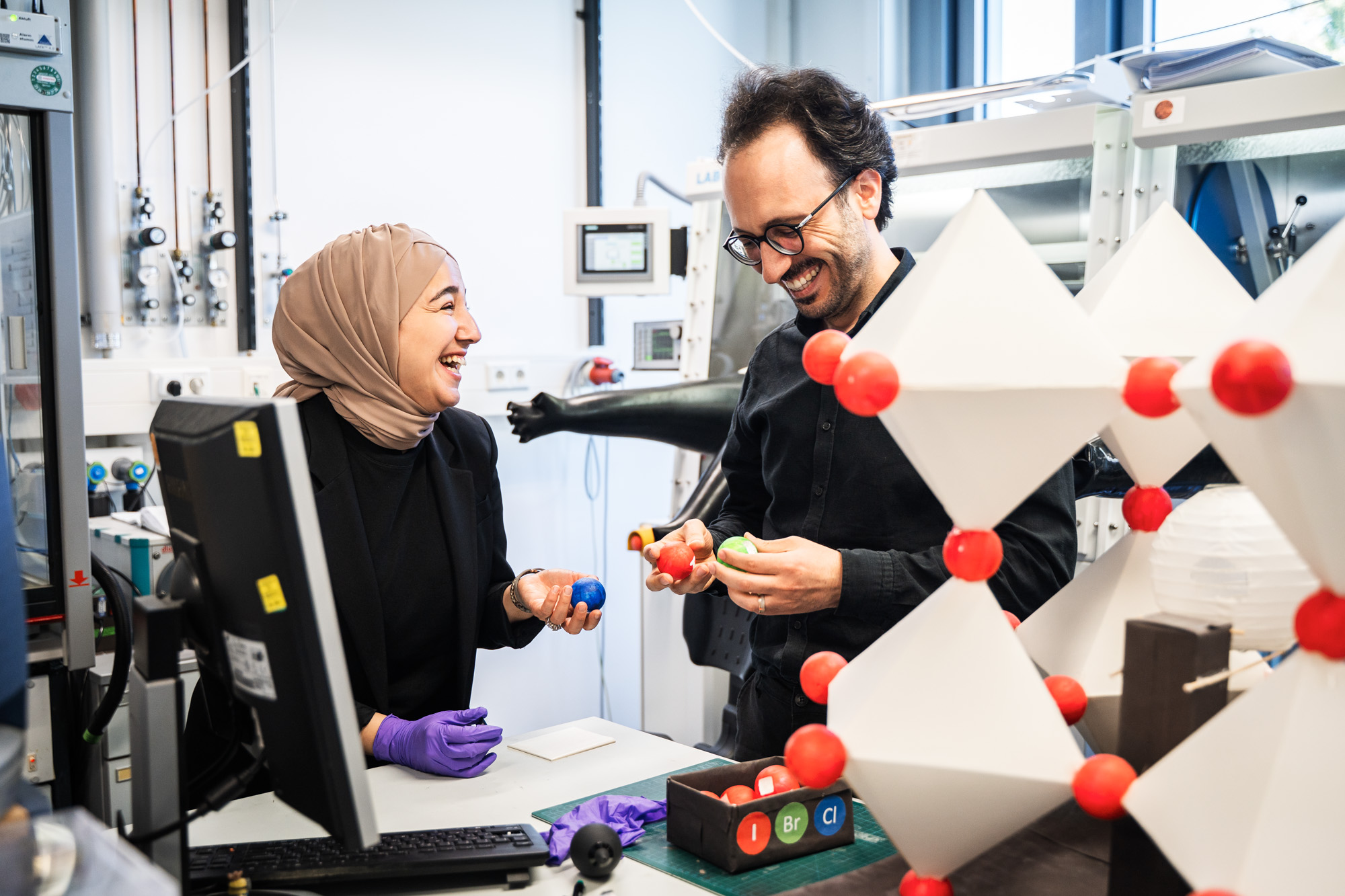
Making the leap to everyday use: Esma Ugur and Erkan Aydin are confident that their research will contribute significantly to bringing perovskites to market as a energy-generating material in the coming years.
(Photo: © LMU / Johanna Weber)
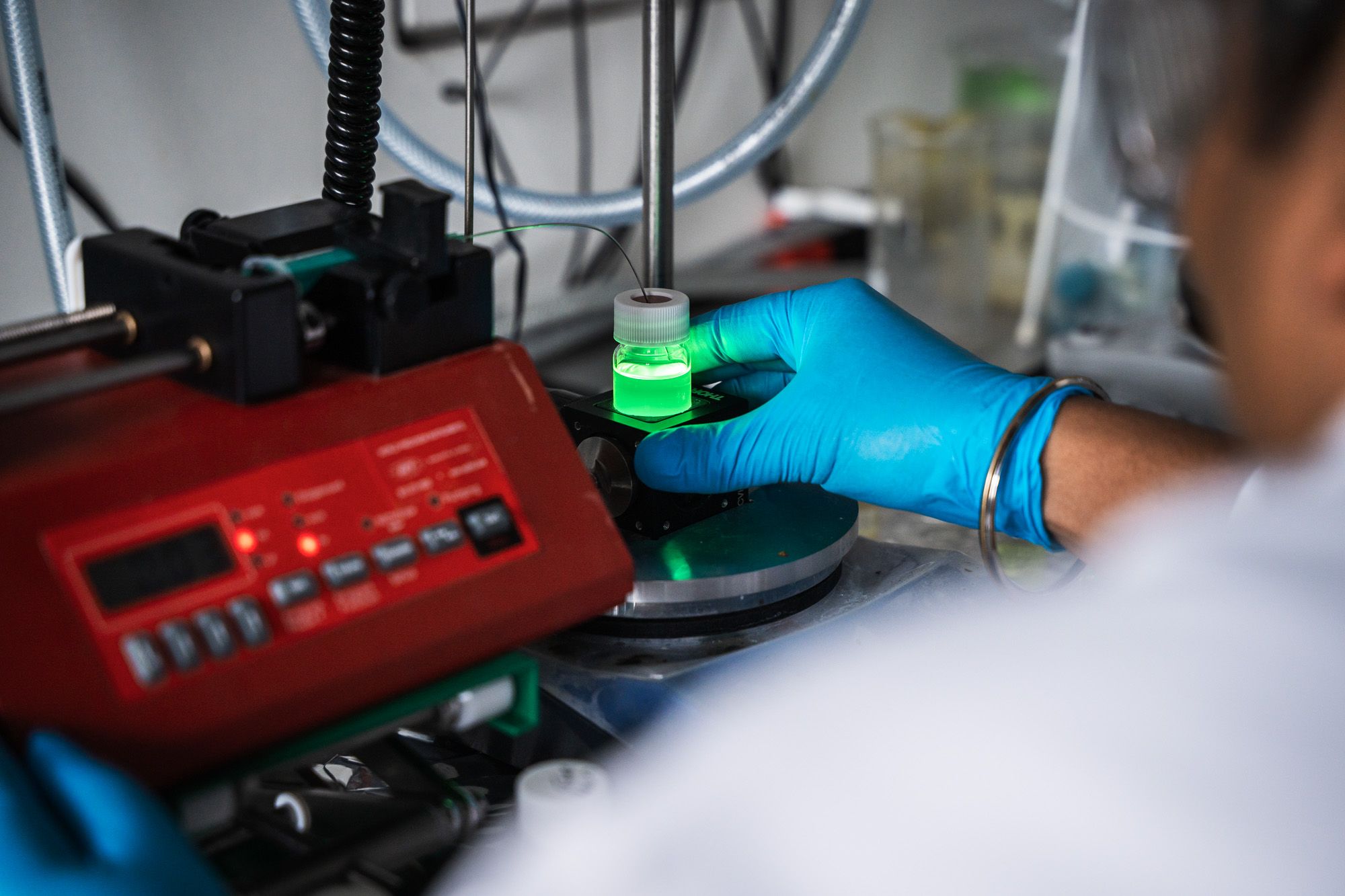
In the lab: Perovskite quantum dots are comparatively easy to manufacture in solution.
(Photo: © LMU / Johanna Weber)

A record-breaking increase in efficiency: In the lab, perovskite cells are now achieving efficiencies of over 27 percent.
(Photo: © LMU / Johanna Weber)
What is a perovskite structure?
The original perovskite calcium titanate CaTiO3 has the following structure: Calcium (Ca) sits at the corners of the crystal cell, titanium (Ti) is in the center, oxygen atoms (O) surround the titanium and form an octahedron. But there are thousands of other perovskite crystals with the general formula ABX3. Positions A, B and X can be occupied by different atoms or molecules without the basic crystal architecture being lost.
Erkan Aydin’s laboratory works in particular with modern mixed-cation perovskite based on formamidinium, methylammonium and cesium as well as lead as the metal center. Examples of halides that are used are iodine and bromine. These multi-component perovskites achieve higher levels of efficiency and better stability than earlier perovskite materials. In what are known as tandem cells, they are combined with conventional silicon cells to convert a wider spectrum of sunlight into energy.
Link to the original source: https://www.lmu.de/en/newsroom/news-overview/news/solar-cells-and-quantum-technology-of-the-future-lmu-researchers-embrace-perovskites-6e4d1843.html