

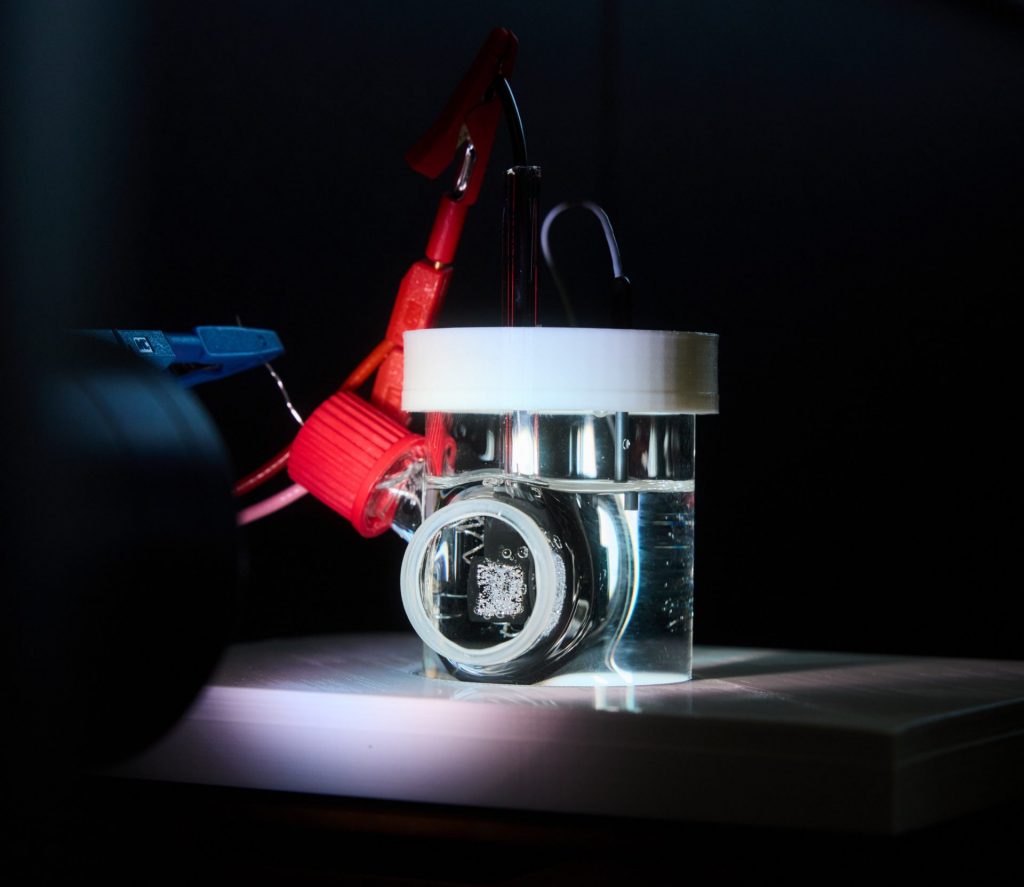
TUM and LMU researchers are developing photoelectrochemical systems that use light energy to generate energy carriers such as hydrogen. (Photo: Julian Baumann)
Sunlight not only provides energy for solar power, but could also be used in the future to produce sustainable fuels directly. To achieve this, researchers are developing photoelectrochemical systems that use light energy to generate energy carriers such as hydrogen. In this context, tantalum nitride (Ta3N5) is a promising semiconductor material for photoelectrodes because it can absorb a large portion of visible sunlight. However, material defects – irregularities in the atomic structure – often impair its performance and stability.
In a recently published study in the journal Nature Communications, research teams from the Technical University of Munich (TUM) and Ludwigs-Maximilians-Universität München (LMU) demonstrated that the outermost nanometers of the surface play a decisive role in determining photoelectrochemical functionality. The researchers systematically compared Ta3N5 thin film photoelectrodes with different types and concentrations of defects and investigated, for the first time, how these affect the surface properties. The researchers, whose work is funded by the e-conversion Cluster of Excellence, characterized the surface and bulk properties separately and showed that surface treatment can significantly improve the efficiency and stability of the photoanodes.
A material for solar fuels
Tantalum nitride has long been considered one of the most promising materials for producing solar fuels by photoelectrochemical methods. As a photoanode, it performs two distinct tasks: the interior of the material absorbs light and transports the resulting charge carriers to the surface. There, they are transferred to the electrolyte and can participate in chemical reactions. Ideally, this happens before the charge carriers are consumed by undesirable reactions or trapped by defects. These defects largely determine the material’s performance. The Munich research teams focused on the role of the composition and structure of the surface. “We often consider a thin film photoanode that is less than 100 nanometers thick as a uniform material with a homogeneous composition and structure. However, our measurements show that the outermost region – less than ten nanometers – has different structural and chemical properties from the bulk regions farther away from the surface,” says Johanna Eichhorn, Professor of Nanoscale Microscopy and Spectroscopy of Energy Materials at TUM. “Only by considering surface and bulk effects separately can we specifically optimize the regions that limit charge transfer and stability.”
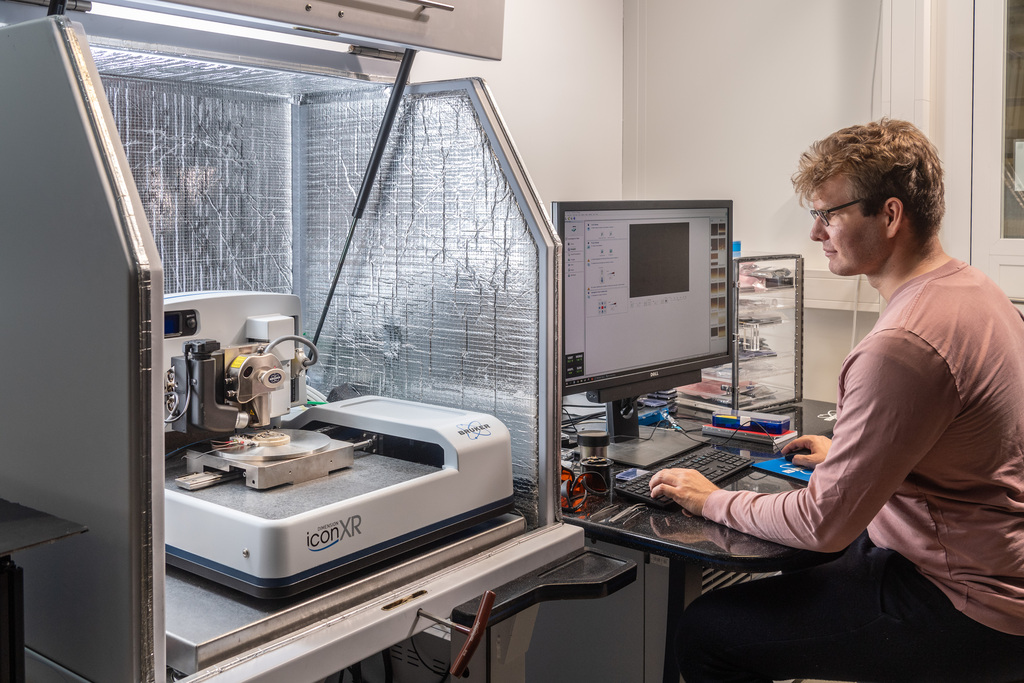
TUM physicist and first author of the study Lukas Wolz in the lab. (Photo: Andreas Heddergott /TUM)
Defect properties also determine surface characteristics
For their study, the researchers deliberately produced tantalum nitride photoanodes with modified material properties. Specifically, they synthesized thin films containing oxygen impurities and varying nitrogen contents. By combining a range of analytical methods – including X-ray spectroscopy, ion-beam techniques, depth-dependent X-ray scattering, electron microscopy, and photoluminescence spectroscopy – the researchers were able to separately reveal the material properties of the surface and bulk. The results showed that the surfaces of all Ta3N5 thin films were more strongly oxidized, more disordered, and contained more defects than the bulk of the material. The extent of these differences depended particularly on the defect properties of the Ta3N5 thin films. When the films contained high levels of oxygen impurities, the researchers observed a relatively thick, amorphous, and oxygen-rich surface layer. By contrast, tantalum nitride thin films that had an almost ideal composition, were nitrogen-rich, or contained only a small proportion of oxygen formed a thinner, more crystalline surface, although with more defects that can impede charge transfer.
The study also elucidates the role of oxygen impurities: on the one hand, they can disrupt the crystal structure; on the other, they can passivate harmful defects. This interplay explains why oxygen-rich Ta3N5 photoanodes often are more stable than more crystalline, lower-oxygen-content variants, despite their more disordered surfaces. The results demonstrate that a highly crystalline surface does not guarantee good photoelectrochemical properties. What matters instead is which defects are present and how they influence the material properties. The targeted and separate control of bulk and surface characteristics is therefore crucial for developing efficient photoelectrodes.
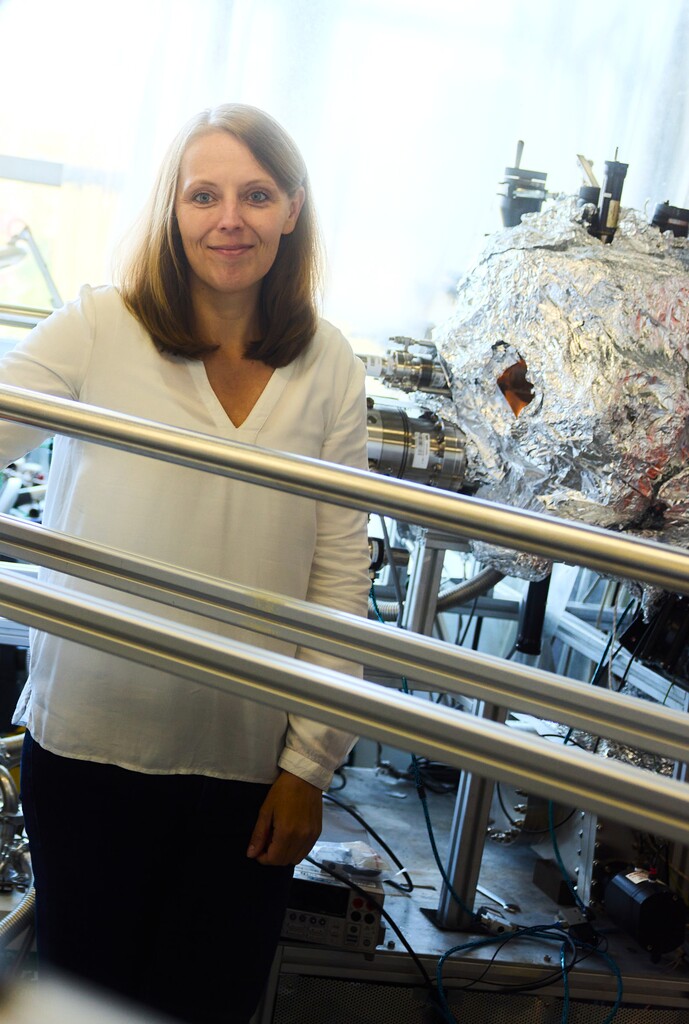
Prof. Johanna Eichhorn conducts research at the TUM School of Natural Sciences and is working on the development of high-performance photoelectrodes for solar fuel production. (Photo: Julian Baumann)
One minute of hydrofluoric acid for improved performance and stability
Based on their results, the team implemented a simple surface modification by treating the Ta3N5 photoanodes with diluted hydrofluoric acid for one minute. The procedure removes large parts of the disordered, oxygen-rich surface layer and exposes the more crystalline regions beneath. At the same time, it improves the wettability of the photoanode and therefore its interaction with the electrolyte. “The brief treatment leads to a significant improvement in the photoelectrochemical properties: the materials generated higher photocurrents, operated at lower potentials, and exhibited greater long-term stability,” says Lukas M. Wolz, first author of the study. “This shows that we can selectively optimize the interface without compromising the beneficial properties of the bulk.”
Considering surface and bulk properties separately
The results provide a design strategy for developing high-performance photoelectrodes for solar fuel production. “With our study, we offer concrete insights into how the efficiency and stability of these materials can be selectively improved through simple surface treatments,” explains Eichhorn. The underlying approach can also be transferred to other systems, as the challenge of relating surface properties to bulk properties also arises in other material systems.
Publication:
Disentangling surface and bulk properties of Ta3N5 thin films, L. M. Wolz, A. Buyan-Arivjikh, J. F. Dushimineza, J. Dittloff, L. I. Wagner, G. Grötzner, J. L. Blänsdorf, M. Kuhl, S. Levashov, J. Kühne, G. Zhou, S. Matich, S. Santra, V. Streibel, F. Munnik, K. Müller-Caspary, I. D. Sharp, P. Müller-Buschbaum, J. Eichhorn
https://doi.org/10.1038/s41467-026-76117-y
Contact:
Prof. Dr. Johanna Eichhorn
Technical University of Munich
TUM School of Natural Science
Professorship for Nanoscale Microscopy and Spectroscopy of Energy Materials
Website: https://www.ph.nat.tum.de/nano/home/
E-Mail: johanna.eichhorn@tum.de