

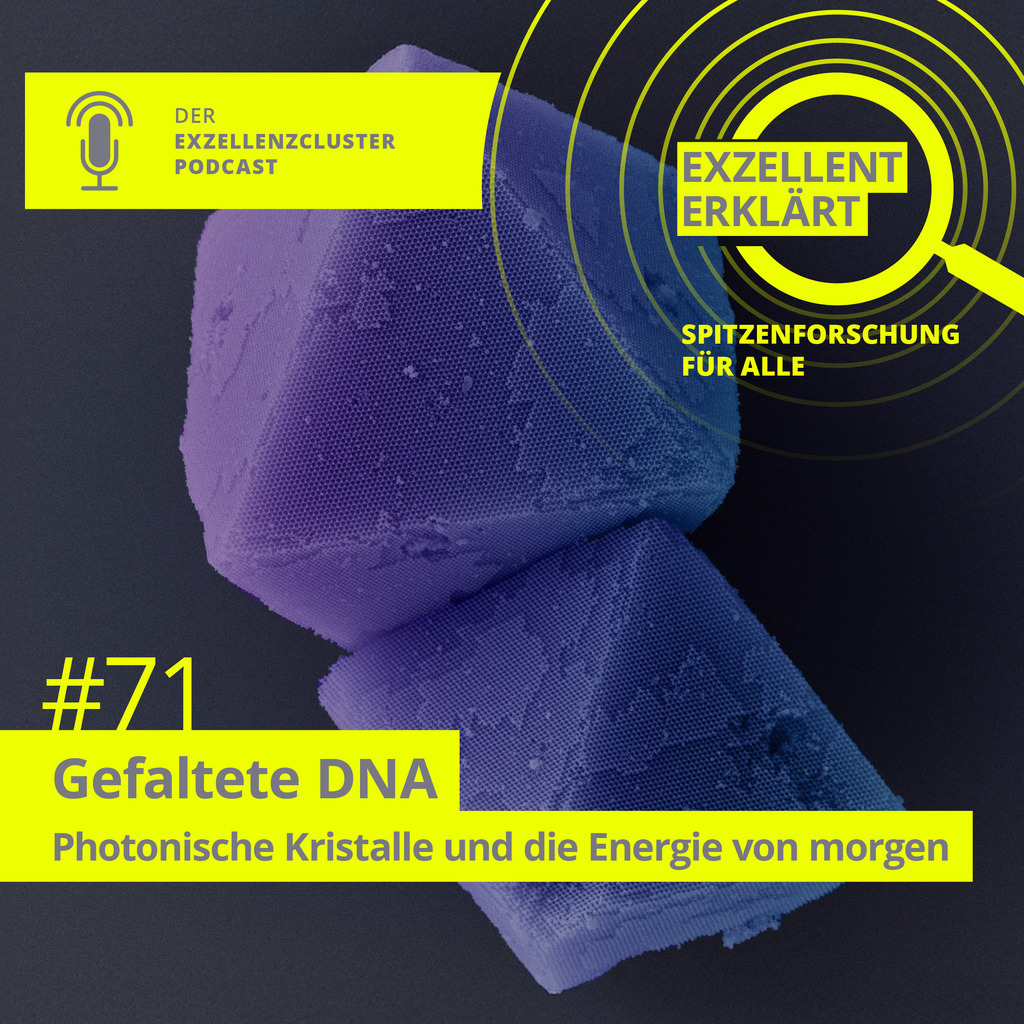
 What does the Japanese art of folding, origami, have to do with energy research? Surprisingly a lot! In this episode, we dive into the world of DNA nanotechnology—a field of research that blurs the boundaries between biology, physics, and materials science. Scientists Philipp Tinnefeld and Tim Liedl explain that DNA is not only suitable as a carrier of genetic information but also serves as a highly precise building material for tiny structures on the nanometer scale.
To achieve this, the researchers use a technique known as DNA origami. It helps them program DNA strands so that they self-assemble into complex three-dimensional shapes. These structures can serve as scaffolds for novel materials that selectively direct light or form photonic crystals, which could enable more energy-efficient computers in the future. At the same time, applications are opening up in catalysis, medical diagnostics, and, in the long term, even in smart nanorobots.
The experts
Philipp Tinnefeld is a professor of physical chemistry at Ludwig Maximilian University of Munich. His research combines chemistry, nanotechnology, and biophysics. His work focuses on DNA-based nanostructures, single-molecule methods, and the development of functional nanomaterials for applications in energy research, sensor technology, and medical diagnostics. As part of the e-conversion Cluster of Excellence, he is investigating, among other things, how complex functions can be realized using precisely arranged molecules on DNA scaffolds.
Tim Liedl is a professor of experimental physics at Ludwig Maximilian University of Munich, specializing in nanoscience and the optical applications of nanomaterials. He is one of the world’s leading researchers in the field of DNA origami and develops programmable nanostructures that self-assemble into complex materials. His work on DNA-based photonic crystals opens up new possibilities for optical technologies, energy-efficient information processing, and innovative materials.
The cluster
The e-conversion Cluster of Excellence investigates the fundamental processes of energy conversion—from the interaction of light and matter to chemical and electronic conversion processes. The goal is to develop new concepts for a sustainable energy supply and to lay the scientific foundations for future energy technologies. To this end, 45 researchers and their teams at the Technical University of Munich (TU Munich), Ludwig Maximilian University of Munich (LMU Munich), and the Max Planck Institutes in Stuttgart and Berlin work closely together. The research ranges from the development of novel materials for solar energy and catalysis to innovative approaches for energy-efficient information processing and nanotechnology.
The podcast
70 clusters of excellence, 1 podcast. “Exzellent erklärt” regularly reports from one of the research consortia funded as part of the federal and state governments’ Excellence Strategy. The journey takes us across the country, and the topics are just as diverse as the locations: from A for African Studies to Z for the Future of Medicine. Tune in again for the next episode and dive into the exciting world of cutting-edge research! If you enjoyed the podcast, subscribe to “Exzellent erklärt” on your favorite podcast platform.